Shrub · Rosaceae
Knock Out Rose
Rosa
Site it in full sun and renew a third of the canes each spring, and the Knock Out reblooms from June to frost.
Full sun
Every 7–14 days
USDA 5–9
3–4 ft · 0.9–1.2 m
Overview
The Knock Out rose reset the standard for landscape roses. Breeder William Radler bred selectively for a shrub that would flower continuously without the routine spraying older roses required, and his original 'Radrazz' entered commerce in 1999. It sits within the family Rosaceae and performs as a durable, low-input landscape shrub rather than an exhibition rose.
Its horticultural value lies in what it does not demand. The shrub is self-cleaning, abscising spent flowers on its own, and it reblooms from June through frost with no deadheading. Bred-in resistance to black spot and powdery mildew, the fungal diseases that discouraged rose growing, keeps the foliage clean, and an established root system tolerates drought.
Its scale is equally practical, holding to a rounded habit of 3 to 4 feet (91 to 122 cm) in most gardens. That dimension suits a foundation bed, a low informal hedge, or a large container, and the extended flowering period earns its place across summer and fall.
Care
The short version: site it in full sun and well-drained loam, water deeply while it establishes, then irrigate only during drought once established. Mulch the root zone, fertilize in spring, and renew about a third of the oldest canes each spring to keep the shrub open and flowering.
Light
Flowering is maximized in full sun, six to eight hours daily, which the plant converts directly into bloom production. It persists in partial shade, but reduced light yields fewer flowers and a more open, elongated habit.
Water
Irrigate deeply and frequently after planting until the roots establish, then reduce, since the shrub is drought tolerant once established. A thorough soak every 7 to 14 days during dry weather suffices, and roughly 3 inches of mulch held clear of the stem conserves soil moisture by limiting evaporation.
Soil
Grow it in well-drained loam at a pH of 6.0 to 7.0. The plant tolerates a range of soils, but drainage is the limiting factor, so amend heavy clay with compost before planting to improve structure.
Temperature
This is a cold-hardy rose, enduring winter minima near -20°F (-29°C) and summer maxima to 100°F (38°C). That tolerance spans most temperate gardens without supplemental protection.
Humidity
Ambient outdoor humidity is adequate, so no target range applies. Air movement is the operative factor, because stagnant air around crowded growth is what permits an occasional fungal lesion to establish.
Feeding
Apply a balanced rose or general-purpose fertilizer once in spring to drive the initial flush of growth. A seasonal feeding sustains flowering through the year, and this low-demand shrub requires nothing beyond that.
Pruning
Pruning requirements are minimal. In spring, apply the renewal method, cutting about one-third of the oldest canes to the soil line to open the shrub and stimulate new basal canes. Deadheading is optional given the self-cleaning habit, though removing spent blooms hastens the next flush.
Repotting
A container specimen seldom needs relocating, but monitor for roots circling or emerging from the drainage holes, water passing straight through with little uptake, and stalled growth. Any of these indicates the plant should move to a larger container.
Size & spacing
The shrub matures to a rounded form of 3 to 4 feet (91 to 122 cm) in height and comparable width. Allow each plant an equal 3 to 4 feet (91 to 122 cm) of spacing so air circulates freely and the canes avoid crowding.
When to plant
Cold hardiness reaching -20°F (-29°C) allows this shrub to overwinter in place across zones 5 through 9. Set new plants out in spring after the last frost, and expect repeat flowering from June until frost terminates the season.
Northern hemisphere
Southern hemisphere
Typical months for a temperate climate: start earlier in warm zones, later where spring frosts linger.
- Plant: spring after last frost
- Harvest: June to frost (repeat blooming spring through fall)
Hardiness
USDA hardiness zones: 5–9
Temperature: down to -29°C
Troubleshooting
Knock Out roses evade most disorders that afflict other roses, so problems are infrequent. The critical exception is rose rosette disease, a fatal infection best identified early. Confirm the symptoms below before intervening.
Reddish witches'-broom shoots carrying dense, pliable thorns
The signature red, broom-like flush points to rose rosette disease, caused by a virus that the eriophyid mite Phyllocoptes fructiphilus vectors from plant to plant, and it is the single disorder capable of killing a Knock Out. Because the virus moves systemically through the vascular tissue, it saturates the whole plant, which is why the new canes bunch and throw a mass of soft, pliable thorns. No cure exists and pruning cannot outrun a systemic infection, so excavate the entire plant with its roots, bag it, and dispose of it before the mite disperses to adjacent roses.
Fix:
- There is no cure; infected plants cannot be saved and the virus is systemic so it cannot be pruned out
- Promptly remove and bag the entire infected plant including roots and dispose of it
- Do not replant a rose in the same spot until remaining roots are gone
Skeletonized foliage and damaged blooms through the summer
Lacy, skeletonized foliage in summer is the work of Japanese beetles, which feed on the soft interveinal tissue and leave the vein network behind, then chew into the open blooms. Hand-collecting them into soapy water in the cool of the morning works because low temperatures depress their activity and slow their escape. A vigorous shrub compensates for light defoliation without loss, so intervention is warranted only when aphids, thrips, or mites accumulate on the tender new growth as well.
Fix:
- Hand-pick Japanese beetles into soapy water
- Tolerate minor feeding on this vigorous shrub
- Manage aphids with a strong spray of water or appropriate controls as needed
Fringed black lesions on leaves preceding yellowing and drop
Round black lesions with fringed margins on the upper leaf surface, followed by chlorosis and defoliation, identify black spot, a fungal disease favored by warm, wet conditions; the Knock Out series carries strong bred-in resistance, so severe infection is uncommon. The pathogen needs prolonged leaf wetness to germinate and spread, which is why sanitation and dry foliage break the cycle. Collect and dispose of the fallen infected leaves, open the canopy to improve air movement, and water at the base rather than overhead.
Fix:
- Remove and dispose of fallen infected leaves
- Improve air circulation and avoid wetting foliage when watering
Toxicity
For households with pets or children, true roses present no toxicity concern. Every part of this rose is non-toxic to cats, dogs, horses, and people, and the petals and hips are edible. The sole genuine hazard is the thorns, which can lacerate an inquisitive nose or puncture a bare hand during pruning.
Safe for
People · Cats · Dogs · Horses · Rabbits · Livestock · Birds
Cats None
The plant carries no toxic principle for cats, so exposure poses no poisoning risk. The thorns are the practical concern, since they can lacerate an investigating nose or paw, and ingestion of a quantity of woody stem may produce gastrointestinal upset.
Dogs None
No toxic compound in this rose threatens dogs. The thorns pose the real hazard, because a dog chewing the canes can puncture its mouth, and a large volume of stem material resists digestion.
Horses None
The ASPCA classifies the genus as non-toxic to horses, so browsing the foliage or petals carries no systemic risk. The sharp thorns remain the one mechanical consideration.
Rabbits None
The foliage and petals present no toxicity to rabbits and can be browsed safely. A thorn can still cause a puncture, so a thornless length of stem makes the safer forage.
Livestock None
Cattle, goats, and sheep can consume the foliage without poisoning. The thorns are the sole liability, and most grazing animals simply feed around them.
Birds None
No component of this rose is toxic to birds, and the thorny canes supply useful cover. The hips that develop after flowering provide a valuable winter food source.
People None
The plant is non-toxic to people, and both the petals and the hips are edible. The thorns are the only injury risk, so wearing gloves during pruning is the sensible precaution.
Although non-toxic, the canes bear thorns that can cause mechanical injury (mouth or paw trauma); ingesting large amounts of stem material could pose a foreign-body obstruction risk.
Varieties
Knock Out functions as a small group rather than one cultivar, with selections that differ in flower color, petal count, and mature size. The following are the ones most often encountered.
Knock Out (Rosa 'Radrazz')
This is the founding cultivar of the group, William Radler's 1999 to 2000 introduction bearing single cherry-red blooms from which every later selection descends.
Double Knock Out
A double-flowered member of the group whose blooms carry a fuller, many-petaled form.
Pink Knock Out
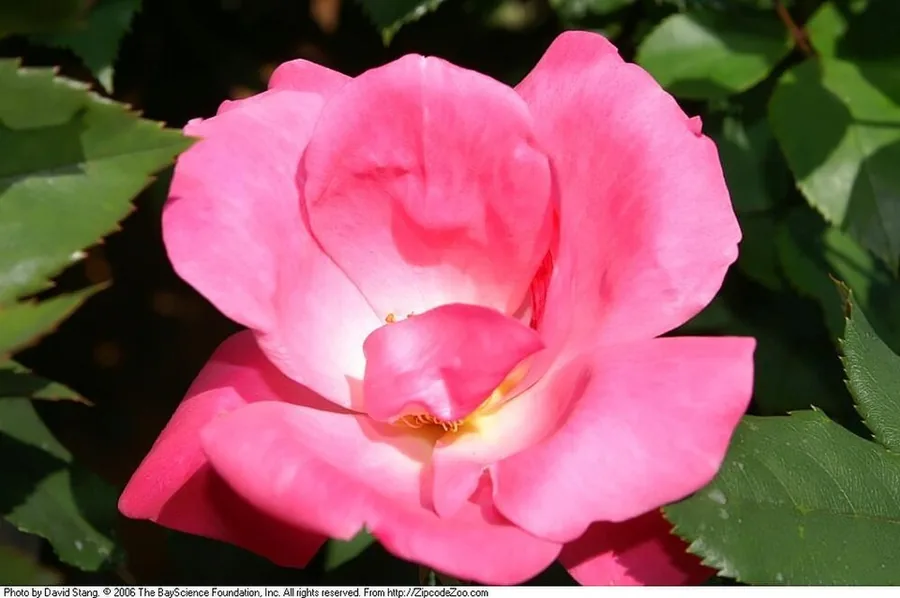
The pink-flowered selection of the series, offering a softer color than the original red.
Rainbow Knock Out
A more compact selection that produces coral-pink blooms centered on a yellow eye.
Petite Knock Out
The miniature-scale selection developed for small beds, edging, and container culture.
How to propagate
Cuttings root with reasonable reliability, but a legal constraint applies before you take material from a plant you own.
Stem cuttingsModerate
Late spring to summer from softwood or semi-hardwood growth · Several weeks to root, established over a season
Propagate from softwood or semi-hardwood cuttings taken in late spring through summer; roots form over several weeks, with full establishment across a growing season. A legal constraint governs the practice regardless of technique. This cultivar is patented under US Plant Patent PP#11836, so propagating it for sale or distribution is restricted for the life of the patent.
Myths
Knock Out roses are impervious to sickness of any kind.
Their bred-in resistance holds against black spot and powdery mildew, the fungal diseases that historically burdened older roses. Resistance, however, is not immunity. Rose rosette disease, a fatal virus with no cure, infects them as readily as any other rose, so the red, broom-like growth that signals it warrants close watching.
Knock Out roses must be deadheaded to continue blooming.
The cultivar is self-cleaning, abscising its spent blooms without help and reblooming from spring to frost on its own. Removing the old flowers only accelerates the following flush, which makes deadheading an option rather than a requirement.