Shrub · Rosaceae
Japanese Kerria
Kerria japonica
Sited in dappled shade and free-draining soil, Japanese kerria opens spring with golden flowers carried on bright green stems.
Partial shade
Every 5–10 days
USDA 4–9
3–7 ft · 0.9–2.2 m
Overview
Japanese kerria is an easy deciduous shrub valued for the golden-yellow flowers ranged along its arching branches in spring. Placed in the family Rosaceae, it stands apart as the only species in its genus, and its bright green stems retain their color through winter after the foliage is shed, so the plant reads as green even when leafless.
The shrub earns its reputation as undemanding because it performs in partial shade where flowering plants are scarce, withstands cold to zone 4, and needs little intervention once its root system is established. Its one management concern is a vegetative habit: it spreads by suckers and will consolidate into a thicket if that growth goes unchecked.
Site it where an informal, arching form is an asset rather than a fault. The branches weave loosely, the main flush of flowers arrives in April and May, and many plants produce a scattered second show through summer. Keep it clear of harsh afternoon sun, which fades the flowers, and off waterlogged ground, which invites rot, and its care requirements drop close to nothing.
Care
The short version: partial shade, loamy free-draining soil, and consistent water through establishment, after which it tolerates drought unaided. Confine pruning to the period just after flowering and remove suckers as they emerge.
Light
Kerria performs best in partial shade and tolerates full shade as well. Withhold strong direct sun, which bleaches the yellow flowers and reduces the density of the bloom.
Water
Supply steady, medium moisture to a new plant while it roots in, irrigating every 5 to 10 days as the top inch of soil dries. Once established it tolerates drought, so deliver water at the base and keep it off the foliage to limit blight.
Soil
Grow it in loamy, well-drained soil of medium fertility. A pH across the range of 5.5 to 7.5 is suitable, and the one substrate to avoid is heavy, saturated clay, in which the roots are prone to rot.
Temperature
The shrub is markedly cold-hardy, enduring winter lows near -29°F (-34°C) and summer highs to 100°F (38°C). That span accommodates a broad range of temperate gardens without protective measures.
Humidity
Ambient outdoor humidity is adequate, so no target value applies. The more consequential factor is air movement through the canopy, because stagnant, humid air trapped among crowded stems is the condition that most favors blight.
Feeding
Kerria has modest nutrient demands. A light spring application of balanced slow-release fertilizer once per season suffices, and excess fertility only drives soft vegetative growth at the expense of flowers.
Pruning
Prune immediately after flowering, since the blooms form on the prior year's wood and a later cut sacrifices the following spring's display. Remove unwanted suckers as they arise, and cut aged, overgrown stems to ground level to rejuvenate the plant.
Repotting
As a garden shrub, kerria seldom occupies a pot. Where one is held in a container, move it to a larger vessel when roots begin circling or escaping the pot or when growth slows.
Size & spacing
Anticipate a mature height of about 3 to 7 feet (90 to 215 cm) and a broader spread near 6 to 9 feet (180 to 275 cm). Allocate that space for the arching form and add margin for the suckers it extends beyond the main clump.
When to plant
Kerria follows a predictable annual cycle worth planning around. Establish new plants in spring or fall under mild conditions, expect the principal flush of bloom in April and May, and anticipate a scattering of repeat flowers through summer. Reserve all pruning for the interval directly after the spring display, since the coming year's flowers are borne on the current season's wood.
Northern hemisphere
Southern hemisphere
Typical months for a temperate climate: start earlier in warm zones, later where spring frosts linger.
- Plant: Spring or fall
- Harvest: April to May with sporadic rebloom in summer
Hardiness
USDA hardiness zones: 4–9
Temperature: down to -34°C
Troubleshooting
Kerria remains healthy with minimal input, though a handful of disorders surface under wet weather or poorly drained soil. Each declares itself first on the foliage, flowers, or roots, so interpret the early symptoms below and intervene before a localized problem progresses through the shrub.
Wilting and dieback tied to darkened, decayed roots
Persistent wilting and dieback in a kerria growing in waterlogged ground point to root rot. Saturated soil starves the roots of oxygen and lets decay organisms take over, leaving dark, softened tissue in place of firm white roots. Because the trouble is drainage, correct the site itself: amend heavy soil with compost to open its structure, reduce irrigation, and never establish the shrub in a low spot that stays wet.
Fix:
- Improve drainage by amending soil with compost
- Reduce watering frequency
- Avoid planting in heavy clay or low wet spots
Purple-margined foliar lesions and dark stem cankers
These lesions signal kerria twig and leaf blight, caused by the fungus Blumeriella kerriae and driven by wet weather that keeps the foliage damp. The pathogen moves from infected leaves into the wood, where an elliptical canker can girdle a stem and kill the growth above it. Excise the cankered wood, clear the fallen leaves that carry inoculum into the next season, and keep water off the foliage with a soaker hose, since dry leaves interrupt infection more reliably than any spray.
Fix:
- Prune out and dispose of diseased stems
- Rake and dispose of fallen infected foliage
- Apply a labeled fungicide such as chlorothalonil on a bi-weekly schedule during wet summer weather
- Switch to soaker hose or drip irrigation to keep foliage dry
Bleached petals and a sparse flowering display
Two site-and-timing errors account for pale, thin bloom. Excess direct sun bleaches the petals, so shift the plant into partial shade, the exposure under which its yellow holds its saturation. The second cause is mistimed pruning: because kerria sets its flower buds on the previous year's wood, cutting before bloom removes those buds, so confine pruning to the window right after the spring display.
Fix:
- Site the plant in partial shade
- Prune only immediately after flowering since it blooms on previous year's wood
Toxicity
For households with pets or children, the assessment is favorable: Japanese kerria is not toxic. The species does not appear on the ASPCA's poison lists and is regarded as safe around cats, dogs, and the rest of the household. Ingestion of a leaf may bring transient gastric upset, as with most plants, but the tissue holds nothing that poisons.
Safe for
People · Cats · Dogs · Horses · Rabbits · Livestock · Birds
Cats None
Kerria carries no compounds toxic to cats, so an occasional nibble poses no poisoning risk. Chewing any fibrous foliage may provoke transient gastric irritation, but the plant itself is benign.
Dogs None
No toxic principle in kerria affects dogs, and even a persistent chewer faces no poisoning. The most likely outcome is short-lived digestive upset from ingesting plant matter, which resolves without intervention.
Horses None
Kerria holds nothing known to injure horses, making it a sound choice near a paddock. A horse that browses a few leaves should show no ill effect.
Rabbits None
The shrub presents no toxicological hazard to rabbits. They may graze the foliage as they would other garden plants, with no cause for concern.
Livestock None
Ruminants such as cattle, goats, and sheep can access kerria without risk, since it contains no compounds documented to harm them. No exclusion from grazing is warranted.
Birds None
Kerria poses no toxic threat to birds. They can perch and forage among the stems with no adverse effect.
People None
The species is non-toxic to people and suits a household with children. No part is cultivated for eating, but a child who samples a leaf faces no real danger.
No special handling required; wear gloves for routine pruning to avoid scratches.
Varieties
A small number of named kerrias reach the trade, separated mainly by flower form, mature size, and foliage color. The following selections are the ones worth identifying by name.
Pleniflora
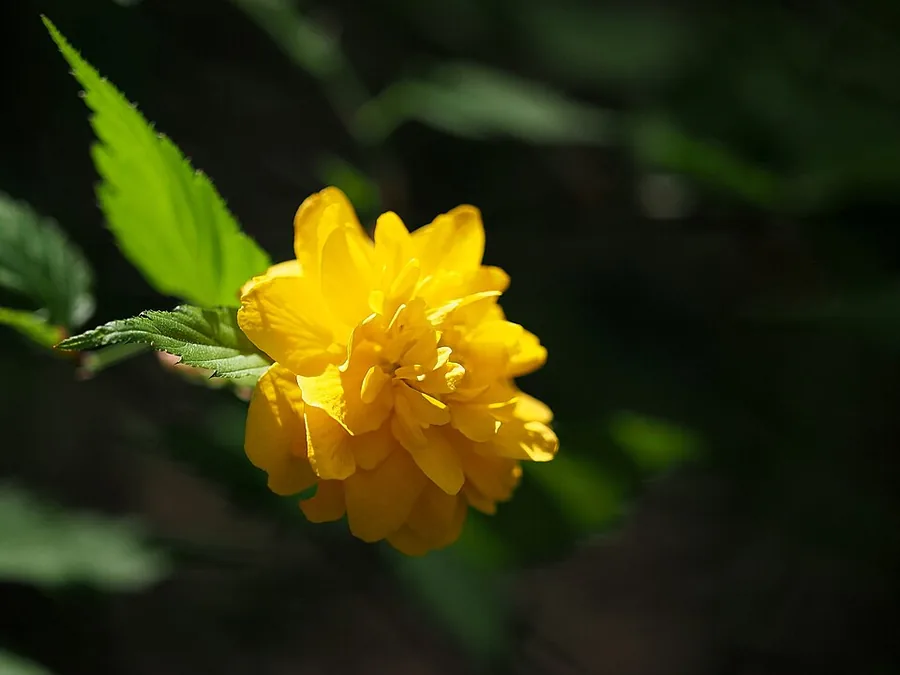
A vigorous cultivar attaining roughly 8 to 10 feet in height and bearing fully double, ball-shaped yellow pompons rather than the single flowers of the species.
Golden Guinea
Selected for large single flowers measuring up to about 2.5 inches across, paired with a notably extended bloom period.
Picta
Carries foliage variegated with a creamy white margin and grows more slowly than the type, though it may revert to plain green shoots if those are not removed.
Albescens
A compact selection of 4 to 5 feet producing soft creamy pale-yellow flowers about 2 inches across.
How to propagate
Kerria propagates with little assistance, which places it among the most straightforward shrubs to increase. It can be divided from its suckers, raised from softwood cuttings, or allowed to layer where its low stems meet the soil.
DivisionEasy
Spring or fall · One growing season
Division exploits the shrub's natural suckering: lift the suckers that emerge around its perimeter and replant them. Performed in spring or fall, a divided sucker roots and establishes within a single growing season.
Stem cuttingsModerate
May to July · Several weeks to root
Propagate by softwood cuttings by collecting terminal tips from May through July and treating the bases with an IBA rooting hormone to stimulate root initiation. Held under warmth and consistent moisture, the cuttings root over the course of several weeks.
LayeringEasy
Spring to summer · One growing season
The species layers readily on its own, since the low arching stems form roots wherever they rest against moist soil from spring into summer. After a growing season the rooted stem can be severed from the parent and transplanted as an independent plant.
Myths
Japanese kerria is a true rose because of its common name.
The common name reflects the rose-like appearance of its yellow flowers rather than any taxonomic identity as a rose. The species does belong to the family Rosaceae, yet it is the sole member of the genus Kerria and is not a true Rosa at all.