Shrub · Rosaceae
Hybrid Tea Rose
Rosa
Given full sun, deep base watering, and a hard spring cut, the hybrid tea rose sustains long-stemmed bloom from summer to fall.
Full sun
Every 3–8 days
USDA 5–9
3–7 ft · 0.9–2.1 m
Overview
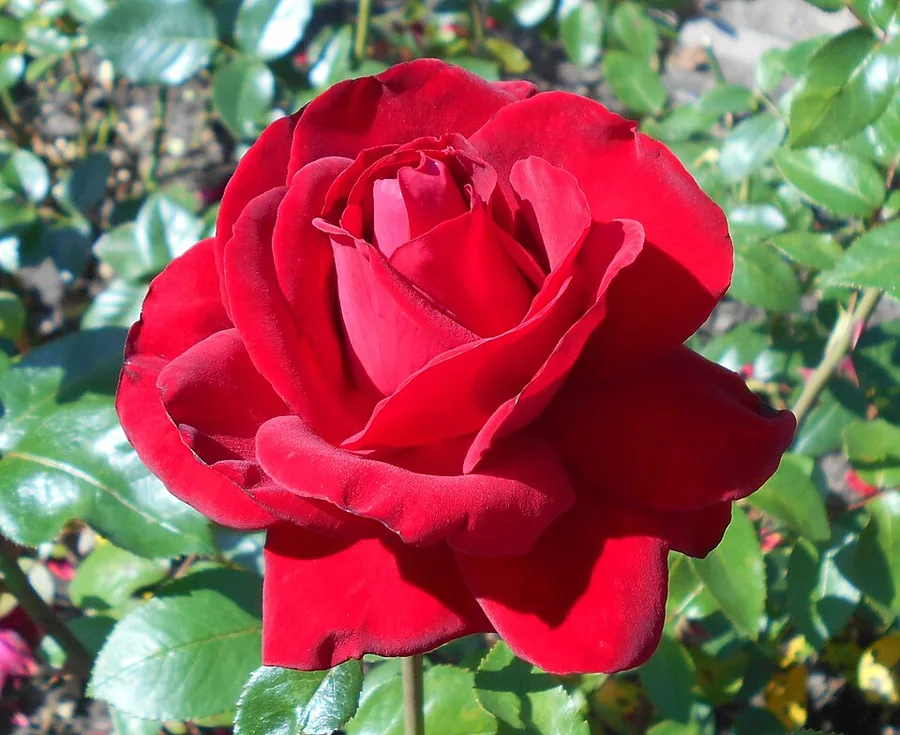
The hybrid tea is the archetypal florist rose: a solitary, high-centered flower borne on a long, straight stem. It arose from crossing the old tea roses with the hardier hybrid perpetuals, a pairing that combined the tea's refined bloom form with the perpetual's constitution. The outcome is recurrent flowering through the season on a plant cold-tolerant enough to overwinter outdoors across zones 5 to 9.
Structurally these are upright, formal shrubs that channel resources into a small number of large flowers rather than a diffuse mass. Mature specimens reach 3 to 7 feet (90 to 210 cm) and depend on full sun, an organically rich medium, and consistent moisture to perform to type. The cost of that concentrated bloom is management, since hybrid teas require severe annual pruning and vigilant disease monitoring.
None of this bars a committed beginner, provided the seasonal cadence is respected. Hard spring pruning, deep basal irrigation, feeding across the bloom flushes, and a dry canopy together yield cutting stems throughout summer. The residual hazard is strictly mechanical, so keep the thorns in mind and glove up when working the plant.
Care
The short version: site it in full sun, a minimum of six hours, in loose, organically rich, well-drained soil. Irrigate deeply at the base so the upper half of the profile dries between cycles, prune the canes hard each spring, and feed across the season until roughly six weeks before frost.
Light
Hybrid teas require full sun, six hours or more of direct exposure daily, to flower freely and hold vigor. They tolerate slight partial sun, but shading produces weak, etiolated growth and a marked drop in flower count. Morning exposure is optimal, since early light evaporates dew and shortens the leaf-wetness window that fungal spores exploit.
Water
Irrigate deeply and infrequently, saturating the root zone and then allowing the upper half of the profile to dry before the next application. In warm conditions this equates to roughly twice weekly, extending toward every 8 days as evaporative demand falls. Deliver water at the base through a soaker hose, because a wet canopy is the precondition for black spot and mildew establishment.
Soil
Establish plants in loose, organically rich, well-drained loam amended with ample organic matter. A pH held between 6.0 and 7.0, near neutral, optimizes nutrient availability. Drainage is the controlling factor, since roses are susceptible to root rot in a chronically saturated profile.
Temperature
The class is broadly cold-hardy, enduring minima near -20°F (-29°C) in zone 5 and summer maxima to 100°F (38°C). Even hardy selections benefit from a winter mulch banked over the graft union in the coldest zones, where the bud union is the most vulnerable tissue.
Humidity
Ambient outdoor humidity is adequate, so no target value applies. Air movement is the operative variable, since stagnant, crowded, humid conditions create the precise microclimate the fungal pathogens require.
Feeding
Fertilize across the growing season, initiating at first leaf-out and repeating after each bloom flush. Apply a balanced rose fertilizer or a slow-release shrub formulation, and terminate roughly six weeks before first frost so that no tender flush is forced into the cold.
Pruning
Prune hard at early spring bud break, retaining three to five of the strongest canes and reducing them to about 15 to 18 inches. Excise any cane thinner than a pencil together with dead, diseased, or crossing wood. Throughout the season, deadhead to a five- or seven-leaflet leaf to redirect energy into successive bloom.
Repotting
Repotting is seldom warranted, as roses favor a permanent in-ground position. A container specimen signals confinement when roots circle the drainage holes, water passes through without uptake, and bloom size declines. Transfer it to a larger container or a bed once those indicators appear.
Size & spacing
A hybrid tea attains 3 to 7 feet (90 to 210 cm) in height at a fast rate, with a spread of 24 to 35 inches (60 to 90 cm). Allocate that spacing so air circulates through the canopy and the foliage dries promptly, which remains the most effective cultural defense against foliar disease.
When to plant
The rose is governed by the seasonal calendar. Establish bare-root or container plants in early spring once the soil is workable and before bud break, execute the hard prune at the same point, and expect recurrent bloom flushes from summer into fall.
Northern hemisphere
Southern hemisphere
Typical months for a temperate climate: start earlier in warm zones, later where spring frosts linger.
- Plant: early spring after the soil can be worked, planting bare-root or container roses before bud break
- Harvest: summer to fall, repeat blooming
Hardiness
USDA hardiness zones: 5–9
Temperature: down to -29°C
Troubleshooting
Rose disorders declare themselves first on the foliage, and both principal fungal diseases propagate on a wet leaf surface. Detecting the earliest symptoms permits intervention before defoliation sets in. Match the sign below, then act while treatment still alters the outcome.
Black spots ringed with yellow, then leaves dropping
The lesions come from black spot (Diplocarpon rosae), the most damaging foliar fungus roses face. Its spores germinate only on leaf surfaces held wet for several hours, which is why warm, wet weather and splashing water drive infection from the lowest leaves upward. Remove the marked leaves, clear the fallen ones that harbor overwintering spores, and irrigate at the base to keep the canopy dry.
Fix:
- Remove and discard infected leaves and prune severely affected canes in late winter
- Rake up and destroy fallen leaves and replace mulch
- Switch to base watering with soaker hoses to keep foliage dry
- Apply a labeled fungicide such as chlorothalonil, mancozeb, myclobutanil, or propiconazole during high-disease periods
White powdery dust on new leaves and buds
The gray-white bloom is powdery mildew (Sphaerotheca pannosa var. rosae), a fungus favored by mild days paired with humid nights and shade. Because it colonizes expanding tissue, it distorts new growth and arrests bud opening rather than spotting mature leaves. Prune out the colonized shoots, raise light and air movement by spacing, and apply a labeled fungicide where the disease persists.
Fix:
- Remove and destroy infected foliage during the season
- Improve air circulation and sun exposure by spacing and pruning
- Apply a labeled fungicide such as sulfur, myclobutanil, propiconazole, thiophanate-methyl, or horticultural oil when needed
Soft green or pink insects crowding the new shoots
These colonies are aphids, most often the rose aphid (Macrosiphum rosae), which concentrate on the tender spring flush and developing buds. Their sap feeding distorts elongating shoots, and the honeydew they excrete coats the tissue below. Dislodge them with a forceful jet of water, then conserve the lady beetles and lacewings whose predation keeps light infestations in check.
Fix:
- Dislodge colonies with a strong spray of water
- Encourage and protect natural predators such as lady beetles and lacewings
- Apply insecticidal soap or horticultural oil to heavy infestations if needed
Toxicity
For households with pets or children, the verdict is favorable: true roses are non-toxic throughout. The ASPCA lists them as safe for cats, dogs, and horses, and the petals and hips are edible for people. The single hazard is mechanical rather than chemical, so respect the thorns and glove your hands before pruning.
Safe for
People · Cats · Dogs · Horses · Rabbits · Livestock · Birds
Cats Safe
A true rose contains no compound that poisons a cat, so ingestion of a petal or leaf carries no systemic risk. The residual concern is purely mechanical: the thorns can lacerate an investigating nose or paw.
Dogs Safe
Ingestion of leaves, petals, or hips presents no toxicity to dogs. What remains is the physical hazard of the prickly canes, since forceful chewing can lacerate the mouth or a paw.
Horses Safe
Roses register as non-toxic to horses, and many will browse the soft new growth and flowers without incident. Only the thorns pose a risk, capable of puncturing the lips and muzzle during grazing.
Rabbits Safe
Rabbits can consume rose foliage and petals without toxic effect, and browsing pressure often strips a plant back to the stem. Remove the thornier canes before offering trimmings to a house rabbit.
Livestock Safe
Cattle, goats, and sheep browse roses with no poisoning risk of any kind. The one variable is mechanical, since the prickles can catch a soft mouth during feeding.
Birds Safe
No part of the plant carries a toxin injurious to birds, and many species take the rose hips as forage through autumn and winter. The plant presents no chemical hazard to them whatsoever.
People Safe
Rose petals and hips are edible and have a long culinary record in teas, jams, and syrups, so the species is safe to cultivate around children. The lone hazard is the thorns, a mechanical rather than chemical risk.
The hazard from roses is mechanical, not chemical: the thorns and prickles on canes can cause scratches and puncture wounds to people and pets, so handle and site plants accordingly. Wear gloves when pruning.
Varieties
Hybrid teas number in the hundreds, yet a small set of established cultivars recurs across gardens and the cut-flower trade. These merit recognition by name.
Mister Lincoln
A tall, vigorous dark red selection reaching roughly 3 to 7 feet and prized for the long, strongly fragrant stems it yields for cutting.
Peace
Among the most extensively cultivated hybrid teas on record, distinguished by large yellow blooms rimmed in soft pink.
Double Delight
A fragrant bicolor in which the creamy white petals develop a progressively deeper red margin under sustained sun exposure.
How to propagate
Roses can be propagated by several routes, none as trivial as rooting a houseplant. The appropriate method follows from the objective, a single garden replicate versus a true commercial plant.
GraftingDemanding
Propagated commercially by T-budding onto a vigorous rootstock during the active growing season · One or more seasons to produce a saleable plant
Virtually every hybrid tea in commerce originates here, the flowering scion T-budded onto a hardier, more disease-resistant rootstock during the active growing season. The rootstock confers its vigor and resistance on the grafted top, but a saleable plant takes a season or more to develop. The technique is exacting, which is why it remains the province of commercial growers rather than the home gardener.
Stem cuttingsModerate
Take semi-hardwood cuttings from current-year stems during the growing season · Several weeks to root, longer to establish
Collect a semi-hardwood cutting roughly 8 inches long from a healthy current-year stem carrying several leaf nodes, at any point in the growing season. Rooting occupies several weeks, with establishment taking considerably longer. Hybrid teas strike less dependably than many other roses, and the success rate is strongly cultivar-dependent.
LayeringModerate
Spring to summer while canes are flexible · One season for roots to form before separating
This is the most accessible technique for the home gardener. While a cane retains flexibility in spring or summer, pin it to the soil surface and hold it in contact. Allow one full season for adventitious roots to develop, then sever the rooted layer from the parent as an independent plant.
Myths
Roses are poisonous to cats and dogs.
The ASPCA classes true roses as non-toxic to cats, dogs, and horses, leaving a thorn laceration as the only genuine risk. The error traces to unrelated species that appropriate the name, such as desert rose and Lenten rose, both of which are legitimately toxic.
Roses should be pruned hard in the fall.
The severe cut belongs to early spring, timed to coincide with bud break at the end of dormancy. Autumn work should be confined to light cleanup and winter protection, because heavy fall pruning exposes the open cuts to cold and predisposes the canes to dieback.