Shrub · Rosaceae
Groundcover Rose
Rosa
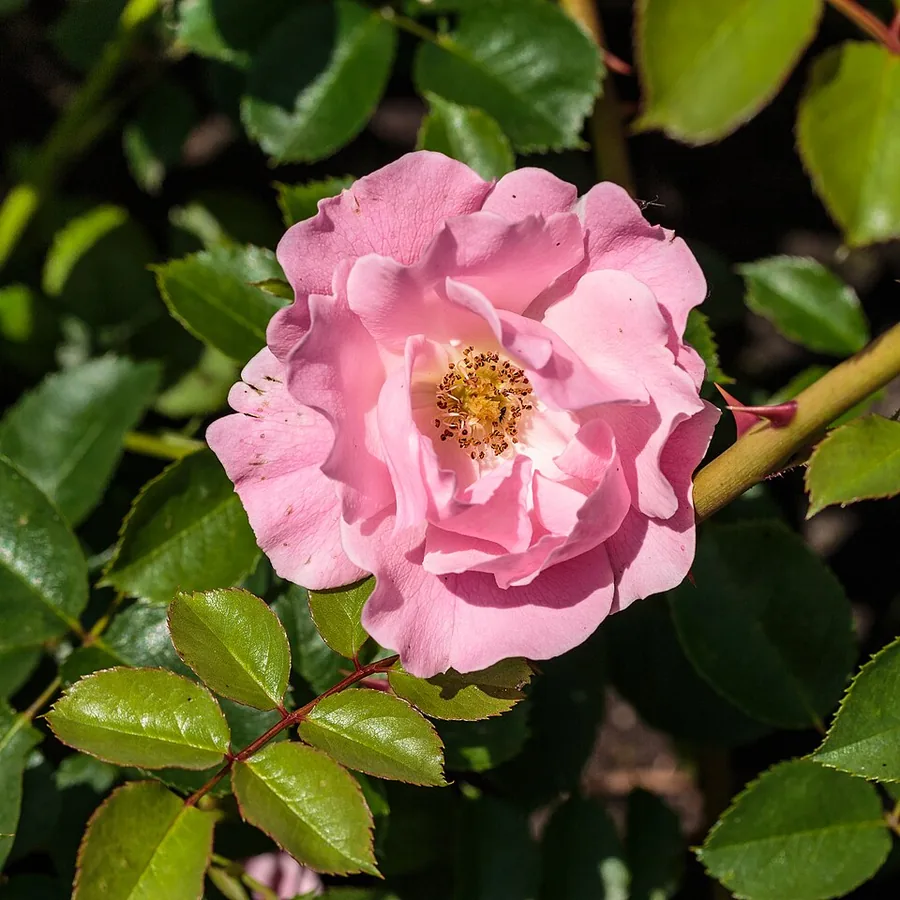
Sited in full sun with open air movement, a groundcover rose carpets the ground in bloom from spring to frost.
Full sun
Every 3–7 days
USDA 5–9
12–35 in · 30–90 cm
Overview
A groundcover rose is a genuine member of the genus Rosa selected for a prostrate, spreading habit rather than the upright form of a hybrid tea. It belongs to the rose family and exchanges the intensive maintenance of a florist rose for a durable, wide-running canopy that closes over a bed or a slope. Most selections hold below 3 feet (90 cm) in height while extending well beyond that in width, so a modest planting achieves substantial ground coverage.
The defining trait is repeat flowering. These roses bloom in successive flushes from late spring through to frost, frequently without deadheading, and the superior selections resist the foliar diseases that compromise their taller relatives. That combination suits them to embankments, borders, and any position where sustained color is wanted without recurring weekly labor.
They rank among the more forgiving roses, though they are not maintenance-free. Establish them in full sun with unobstructed air movement around the canes and keep irrigation off the foliage, and they return a long, heavy flowering season. Confine them to damp shade and the still, humid microclimate favors black spot and mildew.
Care
The short version: full sun, a fertile and well-drained soil, deep irrigation roughly twice weekly delivered at the base rather than overhead, a light prune in late winter, and adequate spacing so air circulates through the canes.
Light
Provide a groundcover rose with full sun, a minimum of six hours daily, which drives both maximum flowering and the healthiest foliage. It tolerates partial sun or light shade, but flowering diminishes and the shaded, slower-drying canopy becomes more susceptible to disease.
Water
Irrigate deeply and regularly, roughly twice weekly according to soil type and weather, and do so in the morning. Direct the water to the base, because free moisture on the leaves is the precondition for black spot and mildew infection.
Soil
Establish it in fertile, well-drained soil amended with abundant organic matter. The species is indifferent to a wide pH band and performs from acidic through neutral conditions, with 6.0 to 7.0 representing the preferred range.
Temperature
Groundcover roses withstand a broad thermal range, hardy from roughly -20°F to 100°F (-29°C to 38°C). That cold tolerance is precisely what enables reliable overwintering across zones 5 to 9.
Humidity
Ambient outdoor humidity requires no management, and no target value applies. Air movement is the operative factor, since a static, crowded microclimate around the canes is what permits foliar pathogens to establish.
Feeding
Apply a slow-release nitrogen fertilizer in spring and again in fall, at approximately one pound of nitrogen per 1,000 square feet distributed across the two applications. Moderate, sustained nitrogen sustains flowering while avoiding the soft, succulent tissue that aphids preferentially colonize.
Pruning
These roses do not require the exacting pruning demanded by hybrid teas. Shear or shape them lightly in late winter to early spring to encourage a denser, bushier form, excise any dead or diseased canes, and give the oldest stems a more severe rejuvenation cut every 2 to 3 years to maintain vigor.
Repotting
Groundcover roses are cultivated in the ground as landscape shrubs and are seldom containerized. Where one is grown in a pot, repot once roots are observed circling the interior or emerging through the drainage holes.
Size & spacing
Mature plants attain approximately 12 to 35 inches (30 to 90 cm) in height and exceed that in spread, reaching around 2 to 4 feet (60 to 120 cm) across. Space each specimen for full development so that air circulates freely and the foliage dries rapidly.
When to plant
Groundcover roses are hardy through zones 5 to 9 and persist as long-lived perennials once established. Set them out in spring after the last frost, prune them lightly in late winter as dormancy breaks, and expect flowering to continue from late spring until frost.
Northern hemisphere
Southern hemisphere
Typical months for a temperate climate: start earlier in warm zones, later where spring frosts linger.
- Plant: spring after the last frost
- Harvest: Continuous bloom from late spring or early summer through fall (May to frost)
Hardiness
USDA hardiness zones: 5–9
Temperature: down to -29°C
Troubleshooting
The majority of problems on a groundcover rose present on the foliage and originate in prolonged leaf wetness or stagnant, crowded air. Detecting the early symptoms and responding promptly prevents a localized issue from establishing across the plant. Identify the pattern below, then intervene while intervention is still effective.
Excessive thorns and reddish witches-broom shoots
These symptoms mark rose rosette disease, a virus vectored by eriophyid mites for which no cure exists. Diagnostic signs include rapidly elongating red shoots, a marked increase in thorn density, and clustered witches-broom growth that fails to normalize. Excavate the plant with its full root system, bag it for disposal rather than composting, and eliminate any wild multiflora roses nearby that act as a reservoir for the pathogen.
Fix:
- Remove and destroy infected plants promptly including roots
- Do not compost infected material
- Replace with resistant plants and avoid planting roses in the same spot immediately
Dark, yellow-haloed lesions on the foliage
The lesions signal black spot, caused by the fungus Diplocarpon rosae, which germinates only where the leaf surface holds free moisture. Infection begins on the lower canopy and progresses upward as spores splash, yellowing and shedding the leaves. Remove the affected foliage, clear fallen debris that harbors overwintering spores, and water at the crown early so the canopy dries before evening.
Fix:
- Remove and discard infected leaves and fallen debris
- Avoid overhead watering and water at the base in the morning
- Improve air circulation and apply a fungicide in humid climates if needed
Powdery white colonies on foliage and shoot tips
The pale, talc-like film is powdery mildew, a fungal colony that spreads across leaves and shoot tips and distorts the expanding new growth. It establishes where air stagnates around crowded or shaded canes. Prune to open the canopy and restore airflow, hold back nitrogen so the plant stops producing the succulent tissue the fungus favors, and apply a fungicide only where infection is advancing.
Fix:
- Prune to improve air circulation
- Avoid excess nitrogen that pushes soft growth
- Apply an appropriate fungicide if severe
Colonies of soft-bodied insects on the new growth
The colonies are aphids, soft-bodied insects that feed by drawing sap from the tenderest buds and shoot tips. Their feeding deforms expanding growth, and the excreted honeydew coats the surface and supports sooty mold. Dislodge the colonies with a forceful water spray, treat persistent populations with insecticidal soap, and conserve lady beetles and other predators that keep numbers in check.
Fix:
- Spray plants with a strong stream of water to dislodge aphids
- Apply insecticidal soap if populations are high
- Encourage natural predators such as lady beetles
Toxicity
For households with pets or children, the profile is reassuring: true roses are non-toxic to cats, dogs, horses, and people, so ingestion of a leaf or petal produces no chemical injury. The hazard is entirely mechanical. The prickles can abrade or puncture, so gloves are advisable during pruning and the canes should sit clear of where pets and children pass.
Safe for
People · Cats · Dogs · Horses · Rabbits · Livestock · Birds
Cats None
The ASPCA classifies true roses as non-toxic to cats, so ingestion of a leaf or petal carries no risk of poisoning. The only injury of concern is mechanical, since the prickles can abrade a curious cat's nose or paws.
Dogs None
A dog can ingest foliage or flowers without any toxic effect, as the genus is documented non-toxic. The real hazard is physical, because the prickles can puncture a snout or a paw pad.
Horses None
Roses are non-toxic to horses, so browsing produces no chemical injury. The sharp canes are the sole liability, which is why the planting should sit clear of where a horse would press against them.
Rabbits None
Rabbits may graze the leaves and stems with no risk of poisoning whatsoever. The prickles are the single hazard worth managing around such small, thin-skinned animals.
Livestock None
Cattle, goats, and sheep can browse the foliage without harm, since no compound in a true rose is toxic to them. Only the prickly canes present any threat, and that is limited to superficial abrasion.
Birds None
The leaves, petals, and hips pose no toxic risk to birds. The dense thorny canes are in fact an asset, offering small birds protective cover and secure perching.
People None
Rose petals and hips are safe for human consumption, and the hips are a recognized source of vitamin C. The prickles remain the only genuine hazard, so gloves are advisable whenever the canes are pruned or handled.
Thorns and prickles can cause scratches or puncture wounds; wear gloves when pruning or handling and place plants where pets and children will not brush against the canes.
Varieties
Groundcover roses are represented by several established series and named selections, each bred toward a slightly different stature, flower color, or disease resistance. The following are the selections most commonly encountered in the trade.
Flower Carpet series
A low, trailing groundcover selection reaching roughly 2 to 3 feet tall and 3 to 4 feet wide, it flowers continuously over glossy, disease-resistant foliage and requires no deadheading.
Drift series
A compact, low-spreading landscape rose that combines groundcover durability with a restrained, tidy mounding form.
Red Meidiland
A vigorous, disease-resistant selection well suited to slope stabilization and low-input landscape use.
Ralph's Creeper
A spreading groundcover rose valued for its bright orange-red blooms borne close to the soil surface.
How to propagate
Groundcover roses can be increased from existing stock by two straightforward methods, either rooting stem cuttings or layering a low cane directly into the soil.
Stem cuttingsModerate
Softwood cuttings in late spring to summer or hardwood cuttings in fall · Several weeks to a few months to root
Collect cuttings from healthy current-season wood, taking softwood material in late spring through summer or hardwood material in fall, and allow several weeks to a few months for root initiation. Note a legal constraint before propagating for sale, since many named groundcover roses are patented and may not lawfully be reproduced for resale.
LayeringEasy
Spring to summer · One growing season
The prostrate, spreading canes lend themselves to layering, as they root spontaneously at any point held against moist soil. Pin a cane down in spring or summer and bury a section, then allow a full growing season for root development before severing the rooted portion as an independent plant.
Myths
Roses are poisonous to dogs and cats and shouldn't be planted where pets roam.
Per the ASPCA, true roses in the genus Rosa are non-toxic to cats, dogs, and horses, so ingestion of a leaf or petal will not poison a pet. The documented hazard is mechanical injury from the prickles, not toxicity. Be aware of nomenclatural confusion, however, since a plant such as desert rose carries the common name yet belongs to a different genus and can be toxic.
All roses need heavy, complicated yearly pruning at exact bud nodes.
Groundcover and landscape roses are low maintenance and do not require the node-precise, structural pruning associated with hybrid teas. A light shearing combined with removal of dead or diseased canes meets their full requirement, in clear contrast to the demanding regime a hybrid tea imposes.