Ornamental · Nyctaginaceae
Four O'clock
Mirabilis jalapa
A warmth-loving tender perennial whose fragrant evening flowers run all summer before the plant sows the next generation itself.
Full sun
Every 3–7 days
50–86°F · 10–30°C
60–80 days
Overview
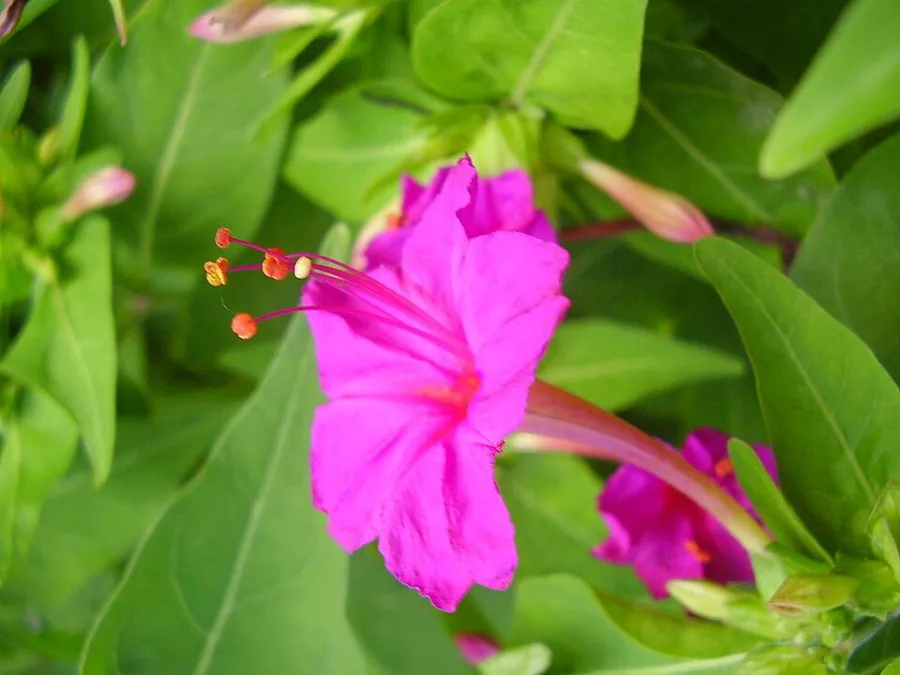
The common name records the plant's photoperiodic habit: the trumpet-shaped flowers remain closed through the day's heat and open in the late afternoon, a response to falling light rather than time. As they open they release a sweet fragrance that draws moths and hummingbirds, the pollinators suited to dusk. Because the species is highly variable, a single bushy plant frequently bears blooms in several colors at once, sometimes striped or splashed on one flower.
Growth is rapid, with mature height reaching 1.5 to 4 feet (46 to 122 cm) within one season. It is a tender perennial grown as an annual across most of its range, since hard frost destroys the top while the plant stores reserves in fleshy, tuberous roots. Those reserves are what allow the same individual to be lifted before winter and replanted year after year.
The cost of that vigor is its reproductive output. Four o'clock sets a heavy seed crop and reseeds itself freely, an asset in a naturalistic border and a maintenance burden in a formal bed. Because the seeds and roots are toxic, knowing where the plant tends to self-sow is a sensible precaution before siting it near pets or children.
Care
The short version: site four o'clock in full sun, hold the well-drained soil evenly moist, and supply a light monthly feed. Pinching the young plant builds structure, and deadheading before seed set keeps self-sowing under control.
Light
Flowering and compact form both depend on full sun, which supplies the energy the plant invests in its heavy bloom. It tolerates partial shade and still performs, but reduced light drives stem elongation, so the growth stretches and lodges in shadier positions.
Water
Hold the soil evenly moist through the season, with closer attention during summer heat when transpiration peaks. The plant favors humus-rich ground that drains well and tolerates occasional saturation, but prolonged waterlogging around the roots is poorly tolerated.
Soil
The ideal medium is well-drained, humus-rich loam, though four o'clock adapts to nearly any soil type. It performs across a pH band of 6.0 to 7.5, which covers most garden soils and removes the need for amendment in typical beds.
Temperature
This is a warm-season plant, productive from roughly 50°F to 86°F (10°C to 30°C), and its growth rate climbs with heat. Frost destroys the top growth outright, the physiological reason it is cultivated as an annual wherever winters are cold.
Humidity
Average outdoor humidity meets its needs, so no target figure applies. What matters more is spacing and airflow, because dense planting both encourages lodging and holds moisture against the stems, raising disease pressure.
Feeding
A balanced general-purpose fertilizer applied about monthly through the growing season sustains continued bloom. Restraint is warranted, since excess nutrition, nitrogen in particular, drives soft, elongated stems that lodge and fracture under their own weight.
Pruning
Little pruning is required, but pinching young growth removes apical dominance and produces a fuller, more self-supporting plant, while cutting back leggy stems restores form. Removing spent plants before seed drop is the most effective brake on self-sowing.
Size & spacing
Expect mature dimensions of 1.5 to 4 feet (46 to 122 cm) tall by 12 to 24 inches (30 to 61 cm) wide. Allotting that full spacing gives the multi-branched framework room to develop and keeps air moving through the canopy.
When to plant
Mirabilis jalapa is heat-driven and frost-intolerant, so timing follows soil temperature rather than the calendar. Sow indoors in late winter to gain a head start, or direct-sow into warmed ground after the last frost. Flowering then runs from midsummer until the first hard freeze ends the top growth.
Northern hemisphere
Southern hemisphere
Typical months for a temperate climate: start earlier in warm zones, later where spring frosts linger.
- Sow: 6 to 8 weeks before the last spring frost; soak seeds overnight to speed germination
- Plant: After all danger of frost has passed, about the same time as tomatoes
- Harvest: Summer through fall; flowers open in late afternoon or early evening and wilt by the following morning
Hardiness
USDA hardiness zones: 9–11
Temperature: down to -7°C
Troubleshooting
Four o'clock is undemanding, and the disorders it presents stem from its own growth habit rather than pathogens or insects. Three patterns account for nearly all complaints: soft stems that lodge, an abundance of self-sown seedlings, and slow, uneven germination. Identify the pattern below and the correction follows from the cause.
Seeds that sit and refuse to sprout
The hard seed coat is the primary constraint, since it restricts the rate at which water reaches the embryo, and cool soil further slows the process. Overnight soaking or nicking the coat improves imbibition and shortens the lag before germination. Sown about 1/4 inch deep with soil held near 68°F to 70°F (20°C to 21°C), treated seed emerges in 5 to 7 days.
Fix:
- Soak seeds in water overnight or nick the seed coat before sowing
- Sow 1/4 inch deep and keep soil at about 68 to 70°F
Weak, brittle stems that flop over and snap
Four o'clock generates abundant soft, branching tissue faster than its stems can lignify to support it, which leaves the structurally weak stems prone to lodging. Excess nitrogen and crowding compound the problem by accelerating that soft growth, so the plant leans and the stems fracture near the base. Pinching young plants redirects growth into a bushier, sturdier habit, generous spacing reduces competition, and staking supports the tallest stems.
Fix:
- Provide stakes or grow among supporting companions
- Pinch young plants to promote a bushier, sturdier habit
- Avoid over-fertilizing with high-nitrogen feeds
Volunteer seedlings popping up everywhere the next year
A single plant deposits a large quantity of viable seed, and that vigorous self-seeding repopulates the bed with volunteers the following season. Deadheading before seed set interrupts the cycle at its source, and removing young seedlings is easiest while their root systems are shallow. In colder climates, lifting and storing the tuberous roots over winter sidesteps reseeding entirely.
Fix:
- Deadhead spent flowers before seeds form
- Remove volunteer seedlings while young
- Dig and store tuberous roots over winter rather than allowing reseeding
Toxicity
This is an ornamental with a real toxicity profile. The seeds and roots are toxic to cats, dogs, horses, rabbits, livestock, and birds, and they are unsafe for people as well, producing stomach pain, nausea, vomiting, and diarrhea on ingestion. The seeds concentrate the greatest hazard, and the roots can provoke contact dermatitis in sensitive skin, so position the plant where pets and small children cannot reach the seedpods.
Toxic to
Cats · Dogs · Horses · Rabbits · Livestock · Birds · People
Cats Toxic
A cat that ingests the seeds, roots, or foliage typically responds with drooling, appetite loss, and vomiting. The seeds carry the greatest risk, so they should be kept out of reach.
Dogs Toxic
Dogs show a comparable response, with drooling, gastrointestinal upset, and diarrhea after consuming any part of the plant. Animals inclined to dig up and chew the roots are the most exposed.
Horses Toxic
In horses the alkaloids present in the seeds and roots can produce drooling and colic, with diarrhea developing soon after. The plant should be kept well away from paddocks and turnout.
Rabbits Toxic
Rabbits should not be allowed to consume four o'clock, as the same toxins cause a painful gastrointestinal disturbance. Trimmings must never be placed in a hutch or run.
Livestock Toxic
Grazing livestock, including goats, sheep, and cattle, can develop abdominal pain and diarrhea after eating the foliage or unearthing the roots. Excluding the plant from pasture is the appropriate measure.
Birds Toxic
For birds the seeds present the greatest danger, and a single pecked seed or chewed leaf can induce vomiting and persistent gut upset. The entire plant is best treated as off-limits.
People Caution
In people the seeds and roots are toxic if eaten, causing stomach pain, nausea, vomiting, and diarrhea, which is why they warrant keeping away from young children who may mistake a seed for a treat. Handling the roots can also redden and irritate sensitive skin, so gloves are advisable when digging them.
Keep seeds and roots away from pets and children; wear gloves if you are sensitive when digging or handling tuberous roots.
Helpline numbers

United States
ASPCA Animal Poison Control: (888) 426-4435 (fee applies)
Poison Control: (800) 222-1222



Canada
Poison Centres: 1-844-764-7669
Varieties
The species is usually offered by flower color alone, but several named selections are distinguished enough in bloom or foliage to seek out deliberately.
'Broken Colors'
Each flower opens striped and splashed with contrasting colors, so a single plant displays a range in which no two blooms are quite alike.
'Limelight'
Chartreuse foliage provides a high-contrast backdrop to neon pink flowers, a pairing legible from a considerable distance.
'Marbles' series
A mixed seed strain yielding bicolor blooms streaked and splotched in color combinations that shift from plant to plant across the planting.
How to propagate
Few ornamentals propagate as readily as four o'clock. Seed gives a fast first-year display, while lifting and storing the tuberous roots preserves a particular plant from one year to the next.
SeedEasy
Sow indoors 6 to 8 weeks before last frost or direct sow outdoors after frost danger passes · Germinates in about 5 to 7 days at 68 to 70°F; blooms the first season
Seed is the most direct method and yields flowering plants in the first summer. Improve and even out germination by soaking the seeds overnight or nicking the hard coat, then sow about 1/4 inch deep and thin to 12 to 24 inches apart. Start indoors 6 to 8 weeks before the last frost or direct-sow into warmed ground once frost has passed, and expect emergence in about 5 to 7 days at 68°F to 70°F (20°C to 21°C).
DivisionModerate
Lift and divide tuberous roots in fall for winter storage, replanting in spring after frost · Stored tubers resprout in spring once replanted in warm soil
In cold-winter regions a chosen plant can be overwintered through its storage organs, much as a dahlia is. Lift the tuberous roots in fall ahead of the first frost, remove loose soil, and keep them in a cool, dry, frost-free place. Replant in spring after the soil warms and the roots resprout for a further season.
Myths
Four o'clock is edible or harmless because it is such a common garden flower.
Familiarity is no guide to safety here. The seeds and roots are toxic on ingestion and cause stomach pain, nausea, vomiting, and diarrhea, while contact with the roots can irritate sensitive skin. Keep the seeds away from children and pets, and wear gloves when handling the roots.
The flowers always open right at four o'clock.
The timing is governed by light, not the hour on a clock. The blooms open in the late afternoon or early evening in response to fading light rather than a fixed time, and they senesce by the following morning. On cool, overcast days the lower light can trigger opening earlier than usual.