Shrub · Rosaceae
Scarlet Firethorn
Pyracantha coccinea
An adaptable rosaceous shrub, firethorn trades hard thorns and sharp drainage for white spring bloom and persistent orange-red winter fruit.
Full sun
Every 7–14 days
USDA 6–9
6–18 ft · 1.8–5.5 m
Overview
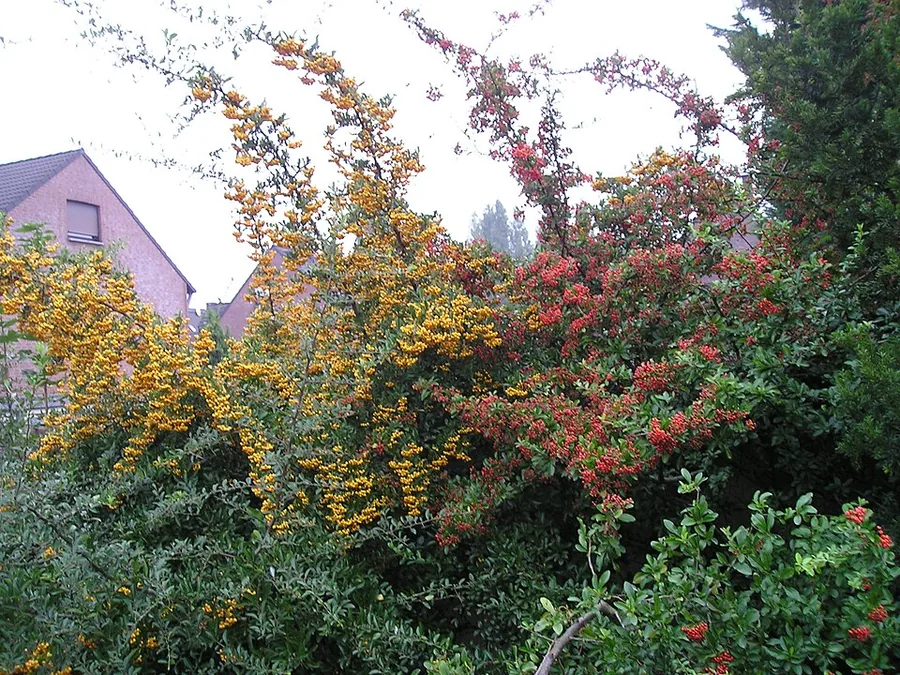
Firethorn is named for two distinct features, the dense crop of orange-red berries it carries into winter and the stiff, needle-sharp thorns set along every branch. It is a fast-growing evergreen shrub in the rose family, and its heat, drought, and cold tolerance let it perform across a wide range once established. In the landscape it functions as a hedge, a barrier, or an espalier trained flat against a wall, the last form exploiting its pliable young wood.
Its ornamental value spans two seasons. Clusters of small white flowers open in late spring, and because the fruit develops directly from those blooms, the late-spring flowering determines the size of the fall crop. Heavy bunches of berries then persist through winter, where birds strip them over the cold months and make firethorn a resource for winter wildlife when little else is in fruit.
That durability carries one practical constraint. The long spur thorns produce painful puncture wounds, so a firethorn placed against a path or doorway will catch anyone who brushes past it. Allow adequate space, position it where the armament serves as a deterrent rather than a nuisance, and work on it only in thick gloves.
Care
The short version: site it in full sun to drive flower and fruit set, supply sharply drained soil to protect the roots, and irrigate deeply only through establishment, after which it draws on its own drought tolerance. Prune in late winter, and wear gloves against the thorns.
Light
Firethorn flowers and fruits most heavily in full sun, because the energy for both processes is light-limited, so a sunny site yields the largest berry crop. It tolerates partial shade and partial sun, but flower and fruit production decline in direct proportion to the shade it receives.
Water
Irrigate deeply during establishment and through prolonged dry heat, then withhold water and let the soil dry between applications. Once the root system is developed, firethorn is genuinely drought tolerant and rarely needs supplemental water, asking for it only every 7 to 14 days at most.
Soil
It adapts to clay, loam, or sand provided the drainage is sharp, since standing moisture around the roots is the one condition it will not tolerate. The species accepts a broad pH range from 6.0 to 8.0, which spans the great majority of garden soils and rarely needs amendment.
Temperature
Firethorn withstands a wide thermal range, from roughly -9°F to 100°F (-23°C to 38°C), combining cold hardiness with heat tolerance. That span is what underpins its reliability across zones 6 through 9.
Humidity
Ambient outdoor humidity is not a limiting factor for this shrub. Air circulation matters far more, because crowded, stagnant conditions keep foliage damp and favor the establishment of fire blight and scab.
Feeding
A balanced slow-release shrub fertilizer applied in early spring meets its modest needs, and in fertile soil even that is optional. Keep the nitrogen low, because excess nitrogen forces soft, succulent growth that fire blight colonizes most readily.
Pruning
Prune in late winter to early spring, and avoid heavy cuts in late summer or fall, since flowers and the subsequent berries form on the previous year's wood and late pruning removes next season's display. The plant tolerates shearing as a hedge or training as an espalier, but the thorns make gloves necessary at every step.
Repotting
Firethorn rarely requires repotting and performs best left undisturbed. In containers, the diagnostic signs are roots circling the pot or emerging from the drainage holes, water passing straight through without absorption, and stalled new growth, each indicating the plant has outgrown its volume.
Size & spacing
This is a large shrub, attaining 6 to 18 feet (1.8 to 5.5 m) in height and 8 to 18 feet (2.4 to 5.5 m) in spread. Allot sufficient space for full development, or commit to routine pruning to hold it within bounds.
When to plant
Firethorn is hardy across zones 6 through 9 and transplants best in spring or fall, when mild conditions let the root system establish before heat or cold stress arrives. Flowering follows in late spring, and the resulting orange-red fruit ripens in fall and persists into winter, sustaining birds through the lean season.
Northern hemisphere
Southern hemisphere
Typical months for a temperate climate: start earlier in warm zones, later where spring frosts linger.
- Plant: Spring or fall
- Harvest: White flowers late spring to early summer; showy orange-red berries fall through winter
Hardiness
USDA hardiness zones: 6–9
Temperature: down to -23°C
Troubleshooting
Firethorn's significant disorders are fungal, bacterial, and insect-driven, and each expresses on a predictable site: the new growth, the fruit, or the lower leaf surface. Early intervention is decisive, because fire blight in particular advances rapidly through living tissue. Identify the symptom below, then treat while the lesion is still contained.
Blackened, wilting shoots that curl into a hooked tip
These symptoms indicate fire blight, a bacterial infection to which Pyracantha is highly susceptible and which moves rapidly down a branch through the vascular tissue. Excise the infected wood at least 12 inches below visible damage in dry weather, and disinfect the blades with alcohol between every cut to prevent transmission to healthy wood. Limit nitrogen and overhead irrigation, both of which accelerate spread, and replant with resistant cultivars such as Mohave or Teton.
Fix:
- Prune out infected wood at least 12 inches below visible damage during dry weather
- Disinfect pruning tools between every cut with 70 percent alcohol or diluted bleach
- Remove and destroy prunings; do not compost
- Choose resistant cultivars such as Mohave, Apache, Teton, or Navaho when replanting
Velvety dark scabs on the foliage and fruit
This is Pyracantha scab, a fungal disease that produces dark sporulating blotches and turns the fruit a cracked olive-brown rather than developing normal orange-red color. Rake up and remove fallen leaves and berries to eliminate the overwintering inoculum, and thin congested growth to improve air movement through the canopy. Scab-resistant cultivars such as Mohave or Fiery Cascade remove the susceptibility at the source.
Fix:
- Rake up and remove fallen leaves and fruit to reduce fungal inoculum
- Improve air circulation by thinning crowded growth
- Plant scab-resistant cultivars such as Mohave, Apache, or Fiery Cascade
Stippled, bleached foliage with dark specks beneath
The bleached, finely stippled appearance results from the hawthorn lace bug, which feeds on the lower leaf surface and deposits the dark, varnish-like fecal spots seen there. Inverting a leaf confirms the diagnosis by exposing the insects and their cast skins. Apply insecticidal soap or horticultural oil to the undersides and repeat as needed, while a strong water jet suppresses a light infestation mechanically.
Fix:
- Spray leaf undersides with insecticidal soap or horticultural oil, repeating as needed
- Encourage natural predators
- Hose off light infestations with a strong water spray
Toxicity
Firethorn is a low-toxicity species, and it does not appear on the ASPCA poison lists. Birds consume the fruit without harm, and the small amount of cyanogenic compounds present is confined to the seeds, so a few berries produce at worst a mild gastrointestinal upset in a pet or child. The dominant hazard is mechanical rather than chemical: the long needle-sharp thorns inflict painful puncture wounds, so handle the plant deliberately and site it away from paths and play areas.
Toxic to
People
Safe for
Cats · Dogs · Horses · Rabbits · Livestock · Birds
People Caution
The berry flesh is essentially harmless, with only trace cyanogenic compounds sequestered in the seeds, so a few cause no real trouble. The operative hazard is the thorns. Their long, needle-sharp spurs deliver painful puncture wounds, so prune in thick gloves and keep children away from the branches.
Cats Mild
Fruit toxicity is low, so an exploratory nibble generally passes without consequence. A cat that ingests a large mouthful may salivate or vomit briefly before recovering. The thorns present the greater risk, since a probing paw or face is readily punctured.
Dogs Mild
Most dogs tolerate a few berries with no adverse effect. Consumption of a substantial quantity may produce loose stool or a single episode of vomiting that resolves without treatment. The more probable injury is a puncture wound from the thorns as a dog forces through the shrub.
Horses Mild
Firethorn is not a recognized poisoning risk to horses, and the fruit contains only trace cyanogenic compounds. A horse that strips a hedge of berries may show a mild, transient digestive upset. The stiff thorns are more likely to abrade the muzzle than the fruit is to cause systemic harm.
Rabbits Mild
An occasional berry will not poison a rabbit, although the fruit is unsuitable as a dietary item and large amounts can disturb the gut. Provide browse appropriate to a rabbit and exclude the firethorn. The thorns can injure a small animal that pushes into the base of the shrub.
Livestock Mild
Cattle, goats, and sheep graze in proximity to firethorn without serious poisoning, consistent with the fruit's low toxicity rating. Heavy consumption of berries may cause minor digestive upset and nothing further. The spur thorns can lacerate grazing stock that lean into the hedge.
Birds None
Birds feed on the orange-red berries freely throughout fall and winter, and the fruit is among the plant's principal wildlife values. No risk exists in this case. The thorny structure additionally provides nesting birds with a well-protected refuge.
Wear thick gloves and eye protection when pruning or handling; the stiff, needle-like thorns inflict painful puncture wounds and localized swelling. Site away from walkways and play areas. Berries are low risk but discourage children and pets from eating large amounts.
Helpline numbers

United States
ASPCA Animal Poison Control: (888) 426-4435 (fee applies)
Poison Control: (800) 222-1222



Canada
Poison Centres: 1-844-764-7669
Varieties
The named firethorns differ chiefly in fruit color, mature size, and resistance to scab and fire blight, the two diseases that most limit the species. The cultivars below are the ones you will encounter most often.
Mohave
Valued for strong resistance to both scab and fire blight, and it carries a heavy crop of orange-red berries.
Apache
A compact, disease-resistant selection that fruits with bright red berries.
Lowboy
A low, wide-spreading form suited to use as a groundcover or for stabilizing a bank.
Lalandei
A vigorous old cold-hardy cultivar bearing orange-red berries that responds well to espalier training against a wall.
Teton
An upright, narrow cultivar with yellow-orange berries and good fire blight resistance.
How to propagate
Firethorn propagates from cuttings or from seed, but only vegetative propagation preserves the genotype of a named cultivar.
Stem cuttingsModerate
Summer, taking semi-hardwood cuttings of current-season growth · Several weeks to root, then grow on for transplanting the following season
Vegetative propagation by cutting is the dependable method for reproducing a named cultivar true to type. Take semi-hardwood cuttings of the current season's growth in summer and treat the bases with rooting hormone to raise the strike rate. Roots form over several weeks, after which the plants are grown on and set out the following season.
SeedModerate
Fall to spring; seed is naturally bird-dispersed · Slow and variable; seedlings of named cultivars will not come true to type
Seed propagation is feasible but slow and inconsistent. The seed requires a cold period to break dormancy, and germination proceeds unevenly from fall into spring. Birds disperse the seed widely after consuming the fruit, but seedlings of a named cultivar do not come true, so cuttings remain the route to a specific plant.
Myths
Firethorn berries are highly poisonous and will seriously harm any child or pet that eats them.
Firethorn is absent from the ASPCA toxic-plant lists, and its fruit is classed as low in toxicity. Birds consume the berries throughout winter, the flesh is essentially harmless, and only trace cyanogenic compounds occur, confined to the seeds. A few berries are safe, and a large quantity at most causes a mild gastrointestinal upset. The genuine danger is the thorns, not the fruit.