Ornamental · Primulaceae
Creeping Jenny
Lysimachia nummularia
A low gold mat that performs in moist ground under shade or sun, and roots clonally fast enough to demand containment.
Full sun
Every 2–5 days
USDA 3–9
2–4 in · 5–10 cm
Overview
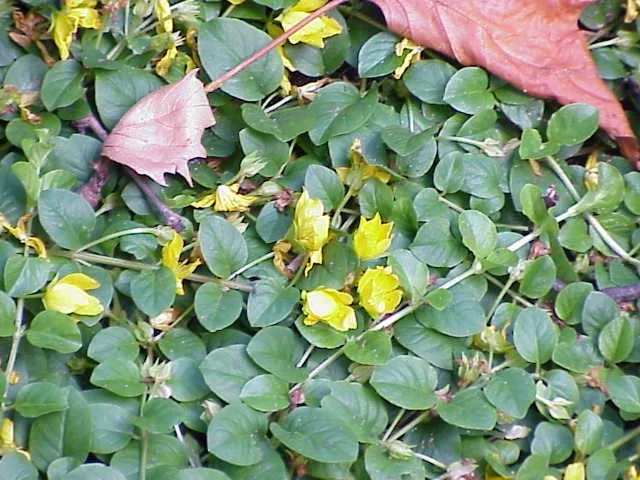
Creeping Jenny is a low, fast-establishing groundcover whose round coin-shaped leaves press against the soil and trail beyond the rims of pots and walls. The golden selections develop chartreuse to gold foliage that brightens shade, whereas the plain green species holds a deeper green. As a member of the primrose family adapted to damp ground, it earns its frequent placement in rain gardens and along pond margins.
The same biology that makes it easy makes it demanding. Because the stems root at every node they touch, a single plug knits into a dense mat within a season, and that mat extends outward through continued clonal rooting. Hardy from USDA zone 3 to 9, it tolerates cold to -40°F (-40°C), so an established stand persists indefinitely.
Its spreading capacity is the operative caution. The green species escapes cultivation and colonizes wetlands, stream banks, and moist woodlands, and it carries invasive or regulated status in parts of the US. Given a defined edge or a container, it serves as a reliable, attractive carpet; released near natural water, it becomes a management problem.
Care
The short version: supply steady soil moisture, then select sun for the strongest gold expression or shade for greener, scorch-resistant foliage. Establish it in rich, damp soil, fertilize rarely, and shear the runners so the colony stays within its bounds.
Light
It performs across the full range from full sun to full shade. Full sun maximizes the gold pigmentation, but it scorches foliage wherever the soil dries, so shade yields greener, more durable leaves at lower risk.
Water
Hold the soil moist to wet at all times, because the shallow root system leaves the plant quick to suffer once it dries. Water every 2 to 5 days, more under heat, and note that it tolerates even shallow standing water at a pond edge.
Soil
Establish it in rich, damp, humus-rich soil with good moisture retention. Beyond that it is undemanding, accepting clay, loam, sand, or shallow rocky ground across a broad pH of 5.5 to 8.0, and withstanding the occasional flood.
Temperature
Cold-hardiness is a defining trait, with comfort from roughly -40°F to 100°F (-40°C to 38°C). That tolerance across USDA zones 3 to 9 partly explains the free spread of an established stand.
Humidity
Ambient outdoor humidity suffices and no target value applies. The plant responds to wet feet, not damp air, so soil moisture is the operative variable rather than the atmosphere.
Feeding
Nutrient demand is minimal. A single application of balanced general-purpose fertilizer in spring satisfies this low-maintenance groundcover, and many growers omit feeding without consequence.
Pruning
Shear the creeping stems at any time to confine the patch. Remove stems that have rooted beyond the intended area, which constitutes the principal ongoing labor the plant requires.
Repotting
In containers, refresh or divide it once it crowds. The signals are a mat overflowing the container edges, a thinning center, or roots filling the pot, at which point division restores vigor.
Size & spacing
Each plant remains low at 2 to 4 inches (5 to 10 cm) tall yet extends 12 to 24 inches (30 to 60 cm) wide and continues beyond. Space accordingly for that rapid spread, allowing room or a defined edge to run against.
When to plant
Creeping Jenny is hardy and indifferent to planting date. Set it out in spring once frost has passed, or in fall, and expect its small yellow cup-shaped flowers in early summer around June.
Northern hemisphere
Southern hemisphere
Typical months for a temperate climate: start earlier in warm zones, later where spring frosts linger.
- Plant: Spring after frost, or fall
- Harvest: Yellow cup-shaped flowers in early summer (around June)
Hardiness
USDA hardiness zones: 3–9
Temperature: down to -40°C
Troubleshooting
With creeping Jenny the limiting factor is placement rather than survival, because the plant is genuinely tough. The practical questions reduce to confining its spread and protecting the gold foliage from scorch. Identify the disorder below, then intervene before a runner or a dry interval gains ground.
Stem nodes root on contact and the colony expands without limit
The governing problem is aggressive vegetative spread, most pronounced in the plain green species. Because each node roots where it contacts soil and detached fragments resprout, the colony advances clonally, smothers neighbors, and colonizes wetlands and stream banks. Excavate runners and rooted segments in full, shear to hold the perimeter, and interpose a root barrier or container wherever natural water is nearby. The golden 'Aurea' selection spreads less forcefully and suits ornamental use.
Fix:
- Pull or dig out runners and rooted stem fragments, removing all pieces since fragments resprout
- Shear or mow back regularly to confine the patch
- Install root barriers or grow in containers to limit spread
- Choose the less-aggressive golden 'Aurea' form for ornamental use
Damp foliage invites fungal disease and slug grazing
Damp conditions favor two pressures: the fungal rust and leaf spot complex, and slugs capable of grazing a mat to near-bare stems where numbers run high. Increasing airflow shortens leaf wetness and curbs the pathogens, while removing the worst-marked foliage limits inoculum; manage the slugs with traps, baits, or hand removal. The colony generally recovers its canopy after slug damage.
Fix:
- Improve air circulation and avoid prolonged leaf wetness for disease
- Remove and discard badly affected foliage
- Control slugs with traps, baits, or hand removal
Marginal scorch where transpiration outpaces a shallow root system
Browned leaf margins are sun scorch, driven by a shallow root system that cannot keep pace with water loss. Pigment expression is strongest in full sun, yet intense dry sun desiccates the margins precisely where soil moisture falls short. Maintaining consistent soil moisture sustains the foliage, and afternoon shade in hot southern climates reduces the transpirational load.
Fix:
- Keep soil consistently moist
- Provide afternoon shade in hot southern climates
- Water more often during heat
Toxicity
For households with animals the verdict is favorable: creeping Jenny is not toxic. It is absent from the ASPCA poison lists and safe around cats, dogs, and other pets, with at most mild gastric upset following heavy ingestion. The operative concern is invasiveness rather than poisoning, so management means containment, not exclusion from curious mouths.
Safe for
People · Cats · Dogs · Horses · Rabbits · Livestock · Birds
Cats None
The species carries no recorded toxicity for cats and is absent from the ASPCA listing. Heavy ingestion may provoke salivation or vomiting, but that reflects simple gastric irritation rather than a toxic mechanism.
Dogs None
Dogs are likewise unaffected toxicologically. A large mouthful of foliage can produce transient gastrointestinal upset and nothing of greater consequence.
Horses Safe
No equine toxicity is documented, so a colony adjacent to grazing presents no poisoning hazard.
Rabbits Safe
Rabbits browse the foliage without toxic effect. As with any unfamiliar forage, a gradual introduction lets the gut flora adapt.
Livestock Safe
Cattle, goats, and sheep face no documented toxic risk from this groundcover.
Birds Safe
The plant presents no toxic hazard to backyard or wild birds foraging among the leaves and stems.
People Safe
Handling and incidental contact carry no toxic risk, and gloves are discretionary. The species is cultivated as ornament rather than food, so deliberate consumption serves no purpose.
No special handling needed for toxicity; gloves optional. The practical caution is containing its aggressive spread, not poisoning.
Varieties
Most gardeners cultivate one of the golden selections in preference to the plain green species. The following two account for the majority of what is offered.
'Aurea' (Golden Creeping Jenny)
Its coin-shaped foliage develops chartreuse to gold pigmentation in full sun and resolves to lime green under shade, and it advances somewhat less forcefully than the green species while still establishing cover quickly.
'Goldilocks'
A very low golden-yellow groundcover extending 1 to 3 feet across, with rounded leaves that may revert to green with age.
How to propagate
Creeping Jenny propagates almost without assistance, the very trait that underlies its spread. Any of three easy methods produces established plants within a few weeks.
DivisionEasy
Spring or fall · A few weeks
Division in spring or fall is the most dependable method, since the plant already roots clonally at the nodes. Lift a clump from a patch margin, separate the pre-rooted segments, and replant them, and they establish within a few weeks.
Stem cuttingsEasy
Spring through summer · A few weeks
Cuttings root readily from spring through summer because adventitious roots form at the nodes. Press a healthy stem against moist soil and it initiates roots at the contact points, yielding a rooted plant within a few weeks.
LayeringEasy
Growing season · A few weeks
Layering proceeds spontaneously throughout the growing season, the same trait behind the species' spread. Trailing stems self-layer wherever a node meets damp ground, rooting within a few weeks without intervention.
Myths
Creeping Jenny is a tidy, well-behaved groundcover you can plant anywhere.
The green species is a vigorous clonal mat-former that roots at every node, escapes cultivation, and colonizes wetlands, stream banks, and moist woodlands, and it carries invasive or regulated status in parts of the US. Plant it deliberately and confine it, and substitute the less forceful golden 'Aurea' selection in ornamental beds.