Bulb · Primulaceae
Florist's Cyclamen
Cyclamen persicum
Hold it cool, bright, and watered from below, and cyclamen flowers steadily through winter.
Bright indirect
Every 5–10 days
50–64°F · 10–18°C
420–540 days
Overview
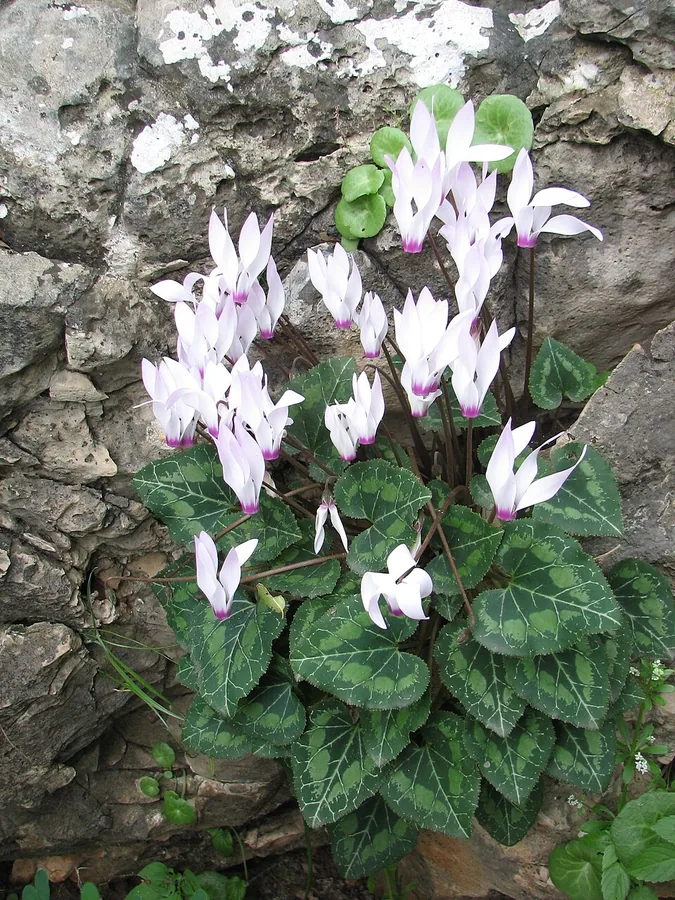
Cyclamen flowers through the coldest months, producing upswept blooms from late fall into spring when most houseplants are quiet. The species sits within the primrose family and grows from a flat tuber held at the soil surface, from which heart-shaped leaves marbled in silver and green arise. The plant most growers know is the florist's cyclamen, a tender hybrid produced for winter sale in pots.
Its requirements invert the usual houseplant pattern. Cyclamen performs in cool, bright conditions rather than warm ones, and sustained warmth shortens its display the way cold drafts stress less hardy species. Watering from below keeps the crown dry, and a bright, cool window position supports weeks of flowering.
By late spring the foliage yellows and dies back, a sequence often mistaken for death and acted on by discarding the plant. The tuber is in fact entering dormancy, a summer rest period from which it resumes growth once temperatures fall again.
Care
The short version: hold it cool and bright, water from below whenever the surface dries to keep the crown dry, feed lightly through active growth, and let the tuber rest dry through summer dormancy.
Light
Cyclamen does best in bright, indirect light, comparable to a window position screened from midday sun. It accepts some partial sun or shade, but direct sun scorches the foliage while deep shade suppresses flowering, since the plant lacks the light it needs to set and hold blooms.
Water
Water only as the surface dries, on a cycle of roughly every 5 to 10 days in active growth, and always from below to keep the crown and tuber dry. Standing moisture on the crown is the primary cause of rot. When the leaves yellow toward summer, reduce watering sharply and allow the tuber to rest.
Soil
Use a rich, light, well-drained loam that drains freely rather than holding water around the tuber. A pH between 5.5 and 7.0 suits the species, placing it in the slightly acidic to neutral range.
Temperature
Temperature is the factor most often mismanaged. Cyclamen requires cool conditions, between 50°F and 64°F (10°C to 18°C), because warmth in the range of a heated room drives premature decline. A bright, cool windowsill meets its needs directly.
Humidity
Maintain 40% to 60% humidity, the ordinary range of most homes. Avoid misting, which wets the crown and encourages rot, and where indoor air is very dry, stand the pot on a tray of damp pebbles to raise local humidity without contact watering.
Feeding
Apply a dilute balanced or low-nitrogen houseplant fertilizer monthly from fall through spring while the plant is in active growth. Suspend feeding once the leaves begin to yellow and the tuber moves into summer rest, when uptake stops.
Pruning
No structural pruning applies. Twist off spent flowers and yellowing leaves at the base rather than cutting them, which removes the entire stalk and avoids the rot-prone stubs that cut stems leave behind.
Repotting
Repot every 1 to 2 years after summer dormancy, timed to the resumption of growth. Roots crowding the pot, a tuber filling the surface, and reduced flowering with smaller leaves all indicate the plant has outgrown its container.
Size & spacing
Cyclamen remains compact, reaching only 6 to 9 inches (15 to 23 cm) in both height and spread. That restrained, mounded habit makes it well suited to a windowsill or tabletop without crowding.
When to plant
Cyclamen follows a winter growth cycle opposite to most plants. Seed sown in late summer flowers the following winter, and indoor plants carry bloom from November into April before the tuber returns to summer dormancy.
Northern hemisphere
Southern hemisphere
Typical months for a temperate climate: start earlier in warm zones, later where spring frosts linger.
- Sow: late summer
- Plant: after frost in zones 9-11 only
- Harvest: winter to spring (November to April)
Hardiness
USDA hardiness zones: 9–11
Temperature: down to -7°C
Troubleshooting
Most failures in cyclamen come back to one of three causes: excess warmth, water retained on the crown, or an unseen mite. Distinguishing a rotting tuber from a tuber entering normal dormancy is the key diagnostic skill, since one demands intervention and the other does not. Match the symptom below and respond early.
Distorted new leaves and malformed flower buds
Cupped, curled, stunted new growth signals cyclamen mites or the related broad mites, microscopic pests that shelter and feed within the unexpanded leaves and buds. Because they attack tissue before it expands, the damage only shows once the leaf or bud opens already deformed, which is why no amount of correction fixes growth already affected. Isolate the plant at the first sign, and discard a heavily infested specimen, since the mites move readily to nearby plants.
Fix:
- Discard heavily infested plants to prevent spread
- Isolate affected plants immediately
- Apply a miticide labeled for cyclamen mites if treating
Softening tuber and a crown that collapses
Moisture held against the crown drives tuber and crown rot, since the dense storage tissue of the tuber cannot shed standing water and pathogens move in once the surface stays wet. A tuber that has gone soft and sour has lost too much tissue to recover. Reverse the cause by watering from below, excise and discard any tuber that has turned mushy, and improve both drainage and air movement so the surface dries between waterings.
Fix:
- Reduce watering and water from below
- Remove and discard severely rotted tubers
- Improve drainage and air circulation
Yellowing foliage and progressive leaf loss
Yellowing through late spring and summer reflects natural dormancy, the tuber's seasonal shutdown as rising temperatures end its growth period, and the plant should be left to rest. The same symptom during the active winter season indicates a different problem, usually heat or excess moisture interrupting growth out of season. Relocate it to a cooler position near 65°F (18°C) and reduce the watering rate.
Fix:
- During dormancy, reduce watering and rest the tuber in a cool spot
- During active growth, move to a cooler location and correct watering
Toxicity
Cyclamen is toxic, and the hazard extends beyond animals to people. Every part contains terpenoid saponins, with the buried tuber holding the highest concentration, so ingestion can cause vomiting and, in quantity, cardiac arrhythmia and seizures. Keep it inaccessible to cats, dogs, horses, and small children, and wash hands after handling the root.
Toxic to
Cats · Dogs · Horses · Rabbits · Livestock · Birds · People
Cats Severe
In cats, even a minor ingestion produces salivation, vomiting, and diarrhea. The tuber concentrates the saponins, so a cat that consumes it may develop cardiac arrhythmia and seizures, and a sufficient dose can prove fatal.
Dogs Severe
Dogs respond to ingestion with pronounced drooling, vomiting, and gastrointestinal upset. Since the tuber holds the highest concentration of toxin, a dog that chews the root risks disturbance of heart rhythm, seizures, and, at high doses, death.
Horses Severe
The saponins induce salivation, diarrhea, and colic in horses, and the equine inability to vomit removes any route to clear the ingested material. A large dose of tuber can disrupt cardiac rhythm and precipitate seizures.
Rabbits Toxic
The same saponins render every part of the plant unsafe for rabbits, with the tuber the most concentrated source. A potted cyclamen must be kept beyond reach, and the foliage should never be available for grazing.
Livestock Toxic
Cattle, sheep, and goats that browse cyclamen ingest the same gastrointestinal toxin, and the buried tuber carries the greatest concentration. Exclude the plants from any grazing animal.
Birds Toxic
The saponins pose the same hazard to birds, so a pet parrot or finch should have no access to either foliage or tuber. Position the plant where an inquisitive beak cannot reach it.
People Caution
No part of cyclamen is intended for consumption, and ingestion can cause vomiting and stomach upset, with the tuber the most hazardous portion. Handling the tuber may also provoke skin irritation, so wash hands afterward and keep it from children.
The tuber/root is the most toxic part. Keep plants out of reach of pets and children, and wash hands after handling as the tuber can cause contact dermatitis.
Helpline numbers

United States
ASPCA Animal Poison Control: (888) 426-4435 (fee applies)
Poison Control: (800) 222-1222



Canada
Poison Centres: 1-844-764-7669
Varieties
The genus ranges from a tender container subject to a fully hardy woodland groundcover. The two below are the forms most often encountered.
Cyclamen persicum (florist cyclamen hybrids)
These tender hybrids supply the winter pot trade, bearing large upswept flowers in violet, lavender, pink, rose, red, and white, frequently with a contrasting darker eye at the center.
Cyclamen hederifolium
The ivy-shaped foliage gives this hardy species its name, and its cold tolerance fits it for outdoor use as a groundcover rather than a container plant.
How to propagate
Cyclamen increases slowly and demands patience by either method. Seed is the standard approach, while division remains a difficult option reserved for the persistent.
SeedModerate
Late summer · About 12-18 months to first bloom
Seed gives the most reliable increase in cyclamen. Sowing fresh seed in late summer yields plants that flower the following winter, but the interval runs 12 to 18 months from sowing to first bloom, so account for that lead time in any planting schedule.
DivisionDemanding
During dormancy · Variable
Dividing the tuber during summer dormancy is possible but unreliable. The cut surfaces frequently rot before roots form, and establishment times are too variable to predict, which is why growers favor seed over division.
Myths
Cyclamen is safe around pets because it is sold as a common houseplant.
Commercial availability is no indicator of ingestion safety. Cyclamen is toxic to cats, dogs, and horses, and the tuber in particular can produce cardiac arrhythmia, seizures, and death when an animal consumes enough. Keep it well out of reach of animals and children.