Bulb · Cannaceae
Canna Lily
Canna × generalis
Give it full sun, rich moist soil, and summer heat, and the canna throws bold leaves and flame-bright flowers until frost.
Full sun
Every 2–5 days
50–95°F · 10–35°C
70–120 days
Overview
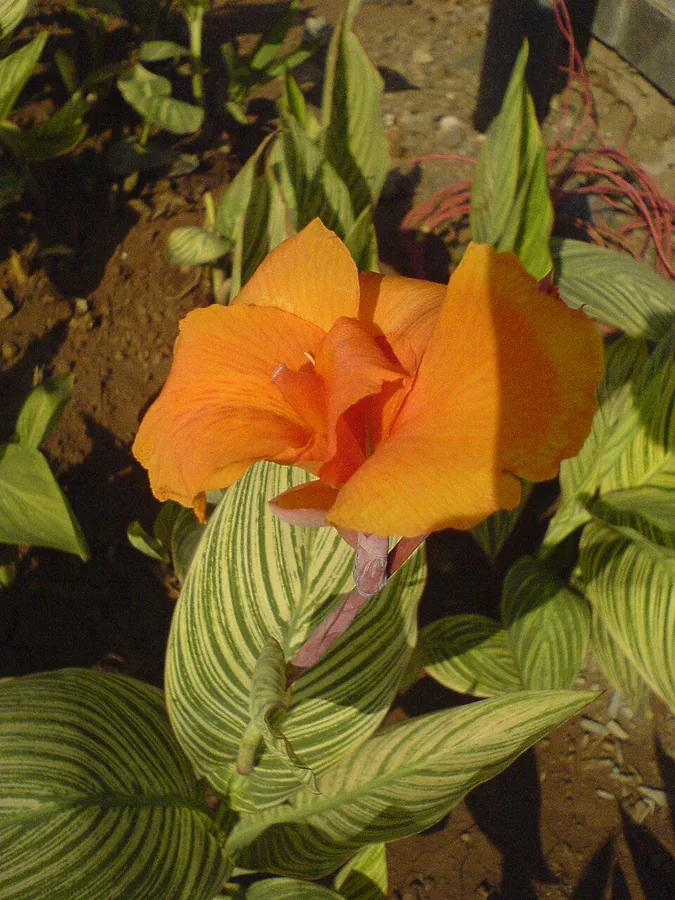
The canna lily lends a tropical look to temperate beds, with broad paddle-shaped leaves and tall flower spikes. The name misleads, because it is not a true lily: it is a rhizomatous perennial in the family Cannaceae, sitting closer to the gingers and bananas. Warmth and rich moist soil push it to grow fast and large, from a knee-high bedding form up to a plant approaching 8 feet (240 cm) tall.
Heat and water are what drive it. Set it in full sun and rich, moist soil, keep the water coming through the hot months, and it returns bloom from midsummer to the first frost. It carries on through conditions that flatten more delicate plants, which is why gardeners use it to anchor a bed or fill a large container.
Cold hardiness is the single hard limit, because the plant has no frost tolerance. Within zones 7 to 10 the rhizomes overwinter in the soil, but in any colder climate you lift and store them once frost has knocked the top growth down. Dividing the rhizomes every few years keeps the clump vigorous and yields free new plants.
Care
The short version: full sun, rich soil kept evenly moist, and steady warmth. Feed monthly through the growing season, divide the clump every few years, and lift the rhizomes for winter anywhere the ground freezes.
Light
Canna needs full sun, six hours a day or more, to flower at its peak. It accepts partial shade or partial sun, but in lower light the bloom thins and the stems stretch and lean as they reach for it.
Water
Hold the soil evenly moist, above all during active growth and hot spells. Canna is one of the few garden plants that handles some standing water, yet an established clump can carry through a short drought. In summer heat, water every 2 to 5 days.
Soil
Plant into rich, moist, well-drained ground amended with plenty of organic matter. It is not particular about pH, accepting anything from 6.0 to 8.0, but drainage is what counts, because waterlogged soil rots the rhizomes.
Temperature
Canna grows best in heat, running happily from 50°F to 95°F (10°C to 35°C). It carries no cold tolerance, so the first frost cuts it down and the rhizomes must be lifted wherever winters freeze.
Humidity
Average outdoor humidity suits it, with no figure to track. Its tropical origins mean muggy summer air never troubles it.
Feeding
Feed monthly with a balanced all-purpose fertilizer across spring and summer while growth is in full swing. For an in-ground clump, a soil test is the most reliable guide to how much it actually needs.
Pruning
Cut away the spent flower stalks to keep fresh bloom forming and the plant looking neat. After the first fall frost in cold zones, take the foliage down to 2 to 3 inches (5 to 8 cm) before lifting the rhizomes for storage.
Repotting
Canna asks for no routine repotting, but a crowded clump does call for dividing every 2 to 3 years. Watch for dense growth, fewer flowers, and rhizomes pushing up through the soil, all telling you the plant has outgrown its space.
Size & spacing
Depending on the type, plants range from 18 inches to 1.5 to 8 feet (46 to 239 cm) tall, so confirm the variety before you site it. Space the rhizomes 1.5 to 3 feet (45 to 90 cm) apart to give the large leaves room to open.
When to plant
Canna depends on warmth and will not survive frost. In cold zones, begin the rhizomes indoors about a month before the last frost, set them out only after the soil has warmed, and the flowers follow from midsummer through the first fall frost.
Northern hemisphere
Southern hemisphere
Typical months for a temperate climate: start earlier in warm zones, later where spring frosts linger.
- Sow: Start rhizomes indoors in pots 3-4 inches deep about 4-6 weeks before the last frost in cold zones.
- Plant: After the last frost when soil has warmed, planting rhizomes 3-4 inches deep and 18-36 inches apart.
- Harvest: Blooms mid-summer through the first fall frost (about July to September).
Hardiness
USDA hardiness zones: 7–10
Temperature: down to -18°C
Troubleshooting
Nearly all canna problems trace to wet soil or a few common pests, and they surface on the leaves or in the rhizomes. Spot the issue early and you can usually rescue the plant or the rest of the clump. Match the symptom below, then act before it carries through the planting.
Rhizomes turning soft and growth that stalls or falls over
What you are seeing is rhizome rot, driven by soil that stays too wet for the tissue to breathe. Dig up a rhizome and the rotted ones read brown, soft, and foul, sometimes together with bud rot or bacterial blight. Discard every rotted piece, set only firm sections back into ground that drains freely, and cut your watering back so the soil can dry between drinks.
Fix:
- Lift and discard rotted rhizomes
- Replant healthy firm sections in well-drained, organically rich soil
- Reduce watering and improve drainage
New leaves emerging streaked, mottled, or twisted
Persistent yellow streaking and distorted growth that watering and feeding never correct usually mean canna mosaic virus or aster yellows. An infected plant cannot be cured. Pull it and destroy it, hold the sap-feeding insects that move these diseases in check, and never take divisions from any rhizome you suspect is carrying virus.
Fix:
- Remove and destroy infected plants to limit spread
- Control insect vectors
- Do not propagate from infected rhizomes
Foliage that is chewed, punched with holes, or rolled tight
Leaf margins rolled or bound with webbing conceal the canna leaf roller, which is the pest you will meet most often. The blunt chewing and the slime trails point instead to Japanese beetles, slugs, and snails. Remove the pests by hand, take off the leaves they have damaged, and rake away debris so fewer of them overwinter to return next season.
Fix:
- Hand-pick caterpillars, beetles, slugs, and snails
- Remove and destroy rolled or damaged leaves
- Apply an appropriate labeled control if infestation is heavy
Toxicity
Reassuring news for households with pets and children: the canna lily is safe. The name confuses people, yet it is not a true lily and holds none of the poison those plants carry. The ASPCA rates it non-toxic to cats, dogs, and horses, and the starchy rhizome is even grown for food in some countries.
Safe for
People · Cats · Dogs · Horses · Rabbits · Livestock · Birds
Cats None
Safe around cats. The ASPCA classes canna as non-toxic, so an inquisitive bite will not poison the animal.
Dogs None
No toxicity for dogs. A dog that bites a leaf or unearths a rhizome risks nothing beyond a mild, passing stomach upset from the fiber.
Horses None
Horses can graze beside canna safely, because the ASPCA rates it non-toxic to them.
Rabbits Safe
The leaves hold no known toxin, so rabbits moving through the garden come to no harm.
Livestock Safe
Cattle, goats, and sheep are not poisoned by canna, since the plant contains no compound that affects grazing animals.
Birds Safe
Birds face no danger near canna, and the hard seeds move through them without injury.
People Safe
No risk to children or adults. The starchy rhizome is in fact eaten as food in parts of the world.
No special handling required for toxicity; wear gloves if sensitive when dividing rhizomes.
Varieties
Cannas span squat bedding types up to towering forms, in colors from pale cream to fiery red. A handful of names come up repeatedly and are worth recognizing.
Tropical Series
A compact line raised from seed and bred to stay small enough for pots and bedding.
South Pacific Scarlet
A seed-grown, award-winning selection that opens bright scarlet flowers.
Canna indica (Indian Shot)
The wild species, carrying flame-red flowers and the hard round seeds behind the name Indian Shot.
How to propagate
Canna increases most dependably by division, which holds a variety true, while patient growers can also raise it from the hard, shot-like seeds.
DivisionEasy
Spring at planting time, or in fall when lifting rhizomes for storage; divide crowded clumps every 2-3 years. · 2 to 6 weeks
Division is the simplest way to increase canna and the only method that holds a variety true to type. Cut the rhizomes apart in spring, or as you lift them in fall, leaving each piece at least one eye, then let the wounds callus over for a few days before replanting. Split a crowded clump every 2 to 3 years and the divisions root in roughly 2 to 6 weeks.
SeedModerate
Spring, started indoors. · Several weeks to germinate
Seed is the slower, less certain route. The hard-coated seeds that earned the name Indian Shot must be nicked and soaked before the embryo can take up water, and even then they take several weeks to germinate. Sow indoors in spring, but understand that seed-grown plants may not come true to type.
Myths
Because it is called a lily, the canna is a true lily and just as poisonous to pets as the dangerous lilies.
Canna is no lily. It sits in the family Cannaceae rather than Liliaceae, and the ASPCA lists it as non-toxic to cats, dogs, and horses. A shared common name is all it has in common with the lilies that actually harm pets.