Tree · Pinaceae
White Fir
Abies concolor
Given room, sun, and well-drained acidic soil, the white fir carries its silvery-blue pyramid for generations.
Full sun
Every 7–14 days
USDA 3–7
30–70 ft · 9.1–21.3 m
Overview
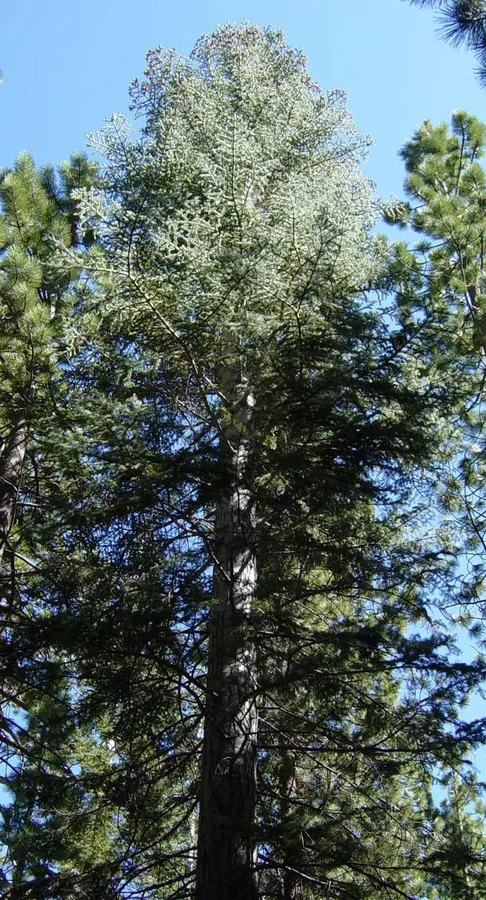
White fir is a true fir native to the mountains of the western United States, now planted widely as a shade and specimen tree well outside that range. It holds a clean pyramidal form and soft blue-green to silvery-blue needles that distinguish it at a glance from spruce and pine. As a slow-growing, long-lived perennial evergreen, a well-sited specimen can persist for a very long time.
Among the firs grown ornamentally, white fir is one of the most adaptable. Its tissues withstand cold to -40°F (-40°C), it endures summer heat better than most relatives, and it copes with urban air and clay soils that cause other firs to struggle. The single limiting factor is drainage: saturated ground excludes oxygen from the roots, and that, more than anything, determines whether the tree prospers or rots.
Most growers plant the straight species, though a handful of blue-needled selections intensify the color. Whichever form you settle on, the planting decision is governed by mature dimensions. This tree grows large, so where you place it matters more than any other choice you make.
Care
The short version: full sun, deep acidic well-drained soil, and steady moisture during establishment. Once settled it demands little beyond space to develop, and the single failing it will not tolerate is a wet, heavy site that suffocates the roots.
Light
Site white fir in full sun, which drives the densest foliage and the strongest needle color. It will accept partial shade and still perform adequately, but an exposed tree captures the light needed to maintain both its tidy pyramidal outline and its full silvery-blue tone.
Water
Supply deep, regular irrigation while the tree establishes and through any drought, because it favors soil that holds even moisture. Let the upper half of the root zone dry between waterings, and never let it stand in saturated ground, where oxygen-starved roots quickly succumb to root rot.
Soil
This fir requires rich, deep, acidic soil with free drainage, sandy or loamy alike. A pH of 5.0 to 7.0 suits its uptake of nutrients, while heavy compacted clay or a low, wet pocket steadily kills it by starving the roots of air.
Temperature
Few garden trees match its cold tolerance. White fir endures winters to -40°F (-40°C) and summer highs near 95°F (35°C), a range that explains why it thrives in climates that overwhelm more tender firs.
Humidity
Ordinary outdoor air is all it needs, so there is no target figure. Of the western firs, this species best withstands dry heat and the swings in humidity found across the broader garden.
Feeding
An established white fir in reasonable soil rarely needs feeding, since it draws what it requires from the ground. Apply a balanced or acidifying tree fertilizer in spring only when a soil test confirms a genuine deficiency, never as routine practice.
Pruning
Leave the tree largely untouched. Remove dead, damaged, or crossing branches in late winter, and protect the central leader so the tree retains the single dominant stem that builds its natural pyramid.
Repotting
none
Size & spacing
White fir is a forest tree by nature, attaining 30 to 70 feet (9 to 21 meters) in height with a spread of 15 to 30 feet (4.5 to 9 meters), and larger still in the wild. Allow it that full footprint and place it well clear of buildings and power lines.
When to plant
White fir enters the garden as transplanted stock rather than direct-sown seed, and the timing follows the soil. Set balled-and-burlapped or container plants out in early spring or in fall, while the ground stays cool and moist, conditions that let the roots extend before heat or hard frost arrives.
Northern hemisphere
Southern hemisphere
Typical months for a temperate climate: start earlier in warm zones, later where spring frosts linger.
- Plant: Plant balled-and-burlapped or container stock in early spring or fall.
Hardiness
USDA hardiness zones: 3–7
Temperature: down to -40°C
Troubleshooting
A healthy white fir requires little, and nearly every problem it develops traces to a wet site or a short list of familiar pests. The needles and the bark register the first symptoms, so inspect them regularly. Identify what you see below, then intervene before the damage reaches the roots or the central leader, where recovery becomes difficult.
Woolly white wax on the bark with knotted, swollen joints
Those waxy white deposits along the bark and branch nodes are the protective wool of the balsam woolly adelgid, a minute sap-feeding insect. As it feeds on the cambium it disrupts normal cell development, twisting the joints into the swollen knots called gouting, suppressing new shoot growth, and ultimately killing the upper crown over several seasons. Cut out the heaviest branches, treat with a labeled horticultural oil or systemic, and keep the tree well watered, since a vigorous tree better resists and compartmentalizes the damage.
Fix:
- Prune out and destroy heavily infested branches
- Apply a labeled horticultural oil or systemic insecticide following the product label and local extension guidance
- Maintain tree vigor with proper watering and avoid drought stress
Fading needles and a thinning crown following a wet season
A canopy that browns and opens up after a saturated season almost always signals Phytophthora or Armillaria root rot at work in the soil. These pathogens thrive where oxygen is scarce, so wet, compacted, or poorly drained ground favors them, and they decay the root system upward from the crown until water and nutrients can no longer move. Decline at this stage is irreversible, so excavate at the collar to confirm rotted tissue, correct the drainage, and never set another fir into the same contaminated ground, where the fungi persist and spread through grafted roots.
Fix:
- Improve site drainage and stop overwatering
- Remove and destroy severely affected trees to limit spread through root grafts
- Avoid replanting firs in the same infected soil
Bronzed, stippled needles laced with fine webbing in the heat
A dusty, bronzed cast to the foliage during hot, dry weather is the feeding signature of spruce spider mites. They pierce individual needle cells and drain the chlorophyll, which produces the stippled, faded look, and they reproduce fastest under drought stress, leaving fine webbing among the foliage. Hold white paper beneath a branch and rap it to dislodge the moving mites for confirmation, then knock the population back with a hard spray of water and reserve a labeled miticide for cases where numbers remain high.
Fix:
- Hose down foliage with a strong stream of water
- Apply horticultural oil or a labeled miticide if populations are high
Spindle-shaped silken bags swinging from defoliated twigs
The small spindle-shaped bags suspended from the twigs are the work of bagworms, larvae that camouflage their casings with the very needles they consume as they feed. Spruce budworm produces similar defoliation by stripping the new growth and buds. Removal works best in stages: handpick the bags through winter and early spring before the eggs inside them hatch, and apply Bacillus thuringiensis in late spring while the larvae are still small, since the bacterium is only effective on young, actively feeding caterpillars.
Fix:
- Handpick and destroy bags in fall through early spring
- Apply Bacillus thuringiensis or a labeled insecticide while larvae are small in late spring
Toxicity
Households with pets and children can relax about this one: white fir is not toxic. It stands in millions of homes each December as a Christmas tree with no recorded systemic poisoning. The needles are sharp and resinous, so a large mouthful may irritate a stomach mechanically, but no chemical toxin is present.
Safe for
People · Cats · Dogs · Horses · Rabbits · Livestock · Birds
Cats None
Because the foliage contains no toxin, a cat that samples a needle takes on no poison. The stiff, resinous needles may irritate the mouth or gut enough to provoke a little drooling or vomiting, and that is the extent of it.
Dogs None
A dog can mouth fallen needles without any toxic effect, since the tree carries nothing poisonous. A large quantity may mechanically irritate the stomach for a day, but the upset resolves without treatment.
Horses None
Fir foliage poses no toxic threat to horses and is not among the conifers tied to equine harm. The needles are sharp and resinous, traits that discourage browsing, so most horses ignore the tree entirely.
Rabbits None
Bark or needles gnawed by a rabbit deliver no poison, as a true fir holds no toxin. The prickly, resin-coated foliage is unpalatable, so rabbits rarely choose to feed on it.
Livestock None
Cattle, goats, and sheep can browse fir without the risk of abortion linked to certain other conifers. The foliage is safe forage, though the sharp needles naturally limit how much any animal takes.
Birds None
Firs offer birds nesting cover and shelter with no toxic hazard from the foliage, and the seeds feed many species. The tree holds nothing harmful to them.
People None
White fir is safe around children, which is precisely why it serves as a Christmas tree in homes every December. The needles are not food, but contact with a stray one carries no risk of poisoning.
Needles are not chemically toxic, but ingestion of needles or sap can cause mild mouth and stomach irritation with vomiting or drooling, and large amounts of stiff needles could pose a GI obstruction risk.
Varieties
Gardens usually feature the plain species, but several selections merit attention for their needle color, their compact habit, or their long-standing role beneath the holiday lights.
Candicans
Among the most intensely colored selections, it produces some of the bluest needles in the species, a vivid silvery-blue that persists through every season.
Violacea
Selected for its glaucous blue-gray needles, this form delivers comparable cool color in a softer, more muted register.
Compacta
A slow, irregular dwarf bearing blue-green needles, it earns a place in small gardens where the towering species could never be accommodated.
Abies fraseri (Fraser fir)
The leading commercial Christmas tree, native to the Appalachians, with short dark-green needles silvered on the underside, but no tolerance for heat.
Abies balsamea (balsam fir)
A northern true fir prized for the strong balsam fragrance that makes it a holiday favorite, yet poorly adapted to the heat and humidity of the Southeast.
How to propagate
White fir multiplies slowly, and the technique you choose depends on the result you want. Seed yields the true species over several unhurried years, while grafting holds the named blue forms true to their color.
SeedModerate
Sow stratified seed in spring. · Several years to a sizable sapling
Seed is the standard method, though it rewards patience. The embryo carries a dormancy that a cold, moist period breaks, so the seed must be stratified before it will germinate, and sowing follows in spring once that chilling is complete. Seedlings develop slowly and are sensitive to hot, dry soil, so a partly shaded site protects them through their vulnerable early years, with several seasons needed to reach a sizable sapling.
GraftingDemanding
Late winter under cover. · 1-2 seasons to a viable graft
Named blue forms such as Candicans do not reproduce true from seed because their color is not reliably inherited, so growers propagate them by grafting onto fir rootstock to preserve the clone. The work is carried out under cover in late winter and demands skill to align the cambium of scion and stock. Allow one to two seasons for the union to knit and the graft to grow on its own.
Myths
Douglas fir is a true fir, the same as white, Fraser, and balsam fir.
Despite the name, Douglas-fir sits in the genus Pseudotsuga and is not a true fir at all. The genus Abies is defined by cones that stand upright on the branch and disintegrate in place, shedding their scales rather than dropping whole, and by needles attached through a flat, round base that leaves the bark smooth when they fall. Douglas-fir betrays its difference with pendant cones that drop intact and carry distinctive three-pointed bracts, while spruces leave woody pegs on the twig where their needles detach.