Introduction
Plantain weed is Plantago, a flat rosette of oval leaves that lies almost level with the grass around it. The same plant pulls in two very different readers. Lawn owners want it gone and foragers want it for dinner, and both of them are right about it. Where the plant came up is what decides which job is yours.
For lawn weed identification, count the veins. Broadleaf plantain (Plantago major) shows 5 to 7 nearly parallel veins running from base to tip on a low basal rosette, and the flower stalks are leafless and rise up to 15 inches (38 cm). There is no milky sap and no spine anywhere on it. Long narrow leaves on the same kind of rosette mean you have buckhorn plantain instead.
Check the numbers before you plan anything. WVU Extension puts a single plant at up to 14,000 seeds, and those seeds stay alive in the soil for 50 to 60 years. Growth starts from a crown that sits right at the soil surface, so mowing does nothing and a hasty pull leaves the crown behind to push up fresh leaves. That one detail explains most of the frustration people have with this weed.
The honest answer covers both jobs at once. Plantain weed in a lawn you feed or spray is a removal problem, and picking leaves off treated turf for a sandwich is a bad idea. Plants that came up in a clean bed or along an untreated path are food, and the young inner leaves are the ones worth taking. Either way, the compaction that invited it is the real target, because loose, healthy soil grows far fewer of them.
Identify Your Plantain Weed First
Which plantain came up in your lawn? Read the leaf blade first. Broadleaf plantain spreads a wide oval leaf, 2 to 7 inches (5 to 18 cm) long, with 5 to 7 nearly parallel veins that run from base to tip. Buckhorn plantain has a narrow, lance-shaped blade that can stretch to 12 inches (30 cm). Both sit flat on the soil as a basal rosette, so shape and veins tell you more than height does.
The flower stalk settles any doubt. Broadleaf sends up a bare stalk up to 15 inches (38 cm) tall, and buckhorn pushes one to 18 inches (46 cm) with a short spike whose stamens stick out in bloom. A mature broadleaf crown spans 6 to 10 inches (15 to 25 cm) across. The genus Plantago holds about 250 species worldwide, 20 of them in California, but these two are the ones you will meet in turf.
Plantain weed identification goes wrong on the small stuff. The plant has no thorns, no milky sap and no papery sheath at the leaf base, so those three negatives rule out most of what else grows in a thin lawn. Leaf hairs vary from source to source, so do not rank them as a test. Root structure gets described three different ways, which makes it just as weak a clue. One extra check does hold up. If the petiole, the leaf stalk, is tinged red where it meets the crown, you have blackseed plantain, a close look-alike. NC State says blackseed's is frequently red-tinged and broadleaf plantain's usually is not.
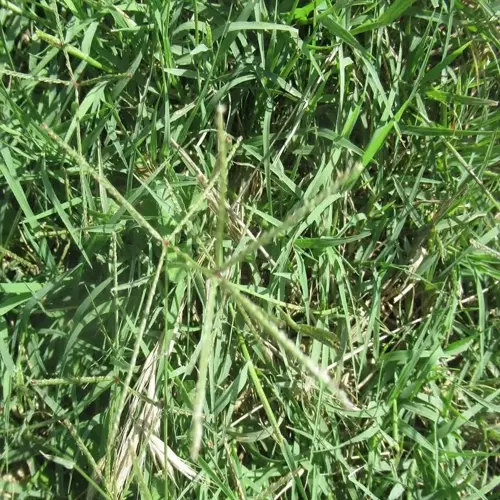
Leaf veins are easy to see and tend to curve along the leaf from base to tip. Plants have a fibrous tap root and leaves tend to hug the ground.
14,000 Seeds and a Tough Crown
Mow a plantain flat and the plant is still there. The reason sits right at soil level. All the growth starts from a crown, a short tough knob where every leaf joins, and UC IPM notes the plant carries on from that crown even after it loses all its foliage. Your mower blade passes above it. A casual yank snaps the leaves off and leaves the crown in the ground, and plantain crown regrowth follows from what stayed behind.
Then there are the seeds. A single plant can push out up to 14,000 of them from those narrow spikes, and seed viability in soil runs 50 to 60 years. Think about one plant you missed last summer. It stocked your soil with enough plantain weed seeds to keep sprouting long after you have sold the house.
Germination has a switch, and the switch is light. Seeds sprout at or near the soil surface once soil warms to 50°F (10°C), and they move fastest near 77°F (25°C). Buried seed just waits. That is why a perennial lawn weed like this pays off on bare ground, because every thin patch and scuffed spot is an open door for the next flush.
Plantain crowns can regenerate new plants, even when cut off at or below the soil surface.
The seedling stage runs 8 to 15 weeks, so the plants you see in midsummer are setting up next year's crop. It also explains why digging out a bad patch can backfire. Turning the soil lifts old seed up into the light, and that light feeds a fresh round of germination. Clear the patch and it can come back thicker, this time as seedlings from the bank you just opened.
What Your Soil Is Telling You
Plantain does not land at random. It fills the gaps where grass has already quit, which makes a patch of it a soil compaction indicator before it is anything else. Broadleaf plantain leans toward alkaline soil that runs low on fertility and gets packed hard by feet, tires and mower wheels. A high pH lawn with a compacted layer just under the surface gives the seed what it wants and gives your grass roots almost nothing.
The bank by my mailbox went brown by early July while the rest of my yard stayed green. Buckhorn plantain held that dry strip in tight, narrow rosettes. A few steps away, along the watered path where everyone cut the corner, broadleaf plantain spread flat over ground I could barely push a trowel into. By UC IPM's reading, buckhorn marks dry, low-fertility ground and broadleaf marks compacted, irrigated ground.
- Compacted ground that gets walked on, parked on or played on.
- Alkaline, high-pH soil carrying low fertility.
- Irrigated turf that is mowed or grazed frequently.
- Lawns where fertilizer has been infrequent or misapplied.
- Dry sites that receive little or no irrigation.
- Poor or thin lawns in droughty areas.
- Low-fertility ground where the grass cover has opened up.
- Roadsides, pastures and hard, dry field edges.
The sources split on water. UC IPM ties broadleaf plantain to irrigated turf that gets mowed or grazed often. The Maryland listing puts dry, compacted soil among the conditions that favor plantain. They agree on the part that decides your diagnosis. Compaction comes first. Read the hard ground, then read the water.
NC State puts adapted cultivar choice and proper fertilizing, mowing and watering ahead of any spray, because bare, compacted ground is the opening plantain needs.
Feeding counts too. Lawns that get fertilizer rarely, or get it at the wrong rate, hand plantain an opening the grass cannot close on its own. Thin turf lets light reach the soil surface, and that is exactly where these seeds germinate. Compacted soil weeds take every gap the grass leaves behind.
How to Get Rid of Plantain Weed
How to get rid of plantain weed depends on two things. How old the plant is, and what month it is. A seedling in May and a mature rosette in October need different handling, and the product that clears one can leave the other standing. WSU Extension says to pick non-chemical options first. In a bed you can cultivate, hoeing or rototilling takes the plants out well, though turning soil also lifts buried seed into the light where it can sprout.
I pulled the compacted strip beside my gravel driveway the morning after a long rain, and the rosettes came up crowns and all. The wet ground let go of them instead of tearing them off. Hand pulling plantain is easier and more complete when the soil is moist, so soak the spot the night before or wait for weather.
Settle broadleaf or buckhorn first, because product choice and expected results are not the same for the two plants.
UMD lists hand pulling or a weeding tool as the primary mechanical control and notes that moist soil makes the job easier. Work to lift the whole crown, since UC IPM says a surviving crown regrows.
Fertilize, mow and water for dense turf as NC State advises, so less light reaches the bare soil where plantain seed germinates.
2,4-D gives the best control of mature plants, and postemergence results are strongest from a fall application.
Buried seed germinates at the surface once soil warms, so plan a return visit rather than one treatment.
Plants past the seedling stage call for a selective broadleaf herbicide. UC IPM rates 2,4-D best on mature plants, with the strongest postemergence results from a fall spray. Species still steers your choice of plantain weed killer. Quinclorac gives fair control of buckhorn and poor control of broadleaf. Contact products, the organic ones included, kill only small seedlings, so spraying one over a full grown rosette burns the leaves and wastes the trip.
Preemergence products stop the seedlings you never see, and the California turf guidance lists four of them. They are atrazine, indaziflam, isoxaben and mesotrione. WVU lists mesotrione for newly seeded cool-season turf, while organic mulch 2 to 4 inches (5 to 10 cm) deep may control seedlings in a bed. Registration varies by state. Confirm the product is cleared where you live, then read the label.
UMD warns against spraying dicamba products over the root zone of trees and shrubs, so read the label before treating plantain in a lawn ringed with plantings.
Eat It or Pull It: How to Decide
Can you eat plantain weed? Yes. Foraging plantain starts with the young leaves, and the plant sits on nearly every list of edible weeds. What settles it for one patch is not appetite. Two facts decide it. What has been sprayed on that ground, and what that ground is. Turf that has had a broadleaf herbicide on it is out, and so is the muddy strip along a ditch or a feed lot fence.
Run both checks before you pick a single leaf. Harvesting plantain and spraying the same square of lawn are opposite plans, so pick one per patch and hold to it. Deciding after the sprayer is empty is how people end up throwing out a full bag of leaves.
- Herbicide history: Rule out turf that has had broadleaf herbicide applied; the citable sources here set no safe interval between treatment and harvest.
- Species: Confirm you have Plantago by checking the flat basal rosette and the 5 to 7 nearly parallel veins.
- Site: Virginia Tech records the plant as common in turfgrass with poor soil or compaction, and also in pastures, ditches and around feed lots; nothing in these sources establishes that plants from such sites are safe to eat.
- Stage: Foragers take young leaves, and UC IPM puts flowering from May through August or September, which is when the seed spikes appear.
- Decide the fate of a patch before you start, because harvesting and herbicide treatment rule each other out.
From my back steps in mid May, the first flower stalks stand over the rosettes like thin gray wires. More keep coming through August and into September. Most mornings I take shears out and cut the spikes at the base while they are still green. The whole lot goes in a bucket, never back on the grass. Ripe seed attaches to shoes and dog feet, so a patch by the door turns into a patch by the shed.
Leaving a patch standing is a fair third option for ground you neither walk on nor spray. On the herbal side there is one honest limit. Plantain tea and leaf poultices go back centuries. Every quantity you find for them comes from consumer health writing, not from universities or peer-reviewed studies. Take the tradition. Skip the numbers.
The citable record covers laboratory and animal activity for this plant, not kitchen quantities. No university or peer-reviewed source reviewed here sets a serving size or a post-treatment waiting period.
What the Research Actually Shows
Online, plantain weed benefits arrive in soft words like soothing and drawing out. The chemistry underneath has names. Two of the big ones are aucubin and plantamajoside. Acteoside and ursolic acid are in there too, and so are the flavonoids luteolin and apigenin. So for each claim the question is which kind of study stands behind it, and that answer changes from row to row below.
Plantain wound healing is the strongest claim here, and one clinical number backs it. A hydroalcoholic extract gel closed 86.85% of the wound area at two weeks against 52.87% for the control, p<0.001, in diabetic foot ulcers and bedsores. That was a gel made from extracted leaves. It was not a leaf pressed onto a cut.
Anti-inflammatory activity sits a rung lower on the same ladder. Leaf extracts cut IL-6 and TNF-alpha, along with PGE2 and IL-1 beta, in colitis models, and the authors tie that drop to COX-2 inhibition. All of that work was done in animals and in a dish. The antibacterial and antiviral numbers come from lab work too, run on extracts at set doses. A dish is a long way from a tea or a poultice doing the same job in your body.
To date, a systematic review on therapeutic effectiveness of this plant species on skin wound healing was not identified in the literature.
Plantain medicinal uses are old. Written records of treating people with this plant go back to the twelfth and thirteenth centuries. Tradition runs that far ahead of the clinical record. Eight hundred years of use is a reason to study a plant, but it is not evidence that the plant works. Most of what you read about this weed still sits at the promising stage.
Common Myths
Mowing the lawn low and often will eventually starve plantain weed out of the turf for good.
Plantain leaves lie flat against the ground and regrow from a crown at the soil surface, so mowing removes almost nothing.
Plantain weed in the lawn is the same plant as the banana-like plantain sold at grocery stores.
They are unrelated. The lawn weed belongs to the genus Plantago, while the cooking plantain is a banana relative grown for its fruit.
Pulling every plantain rosette you can see clears the problem out of the lawn permanently.
Crowns regenerate even when cut off at or below the soil surface, and digging can bring buried seed to the surface, where the light it needs reaches it.
Centuries of herbal tradition prove that plantain leaf heals human wounds faster than standard care.
One clinical gel trial showed 86.85% wound closure at two weeks against 52.87%, but a 2019 protocol reported no systematic review of that evidence had been identified.
Plantain weed only turns up in neglected lawns that nobody ever waters, feeds, or mows properly.
It also colonizes irrigated, frequently mowed turf, because compaction and low fertility open the ground more reliably than neglect alone.
Conclusion
Start with the patch you can see today. Water it, let the soil soak through, then lift the young rosettes with a weeding tool so the whole crown comes up with the leaves. Older plants in the middle of the lawn can wait, because they will still be there in fall and that is the better moment to hit them.
When to treat plantain has one good answer, and fall is it. A fall application of 2,4-D gives the strongest control on mature plants, while contact sprays only burn down small seedlings. Cut the flower stalks from May onward so the plants you have now do not fund next year's crop.
Keep the two halves of this plant apart on the ground itself. Never eat leaves from a lawn you have sprayed, since none of the sources behind this post publishes a waiting period between a broadleaf herbicide and a meal. Pick one bed or one fence line where nothing gets treated, and do your harvesting plantain there. Everything else is removal ground.
One plant drops up to 14,000 seeds that stay alive in the soil for 50 to 60 years, so plantain weed control is a yearly round rather than a job you finish. Dense turf carries most of that load once the bare spots close, because the seed needs light to sprout and a thick stand never gives it any. Feed the lawn, break up the worn strips where feet pack the ground, and the count drops each season.
Eat it or pull it, decided by where it came up.
Glossary
- Alkaline soil
- Soil with a pH above 7, which limits how easily some nutrients reach plant roots.
- Basal rosette
- A circle of leaves that all grow from one point at ground level rather than up a stem.
- Crown
- The short, tough growing point where the leaves meet the roots at the soil surface, from which a plant regrows after being cut.
- Ochrea
- A papery sheath that wraps the stem at a leaf joint in some plant families, and which plantain does not have.
- Petiole
- The stalk that connects a leaf blade to the base of the plant.
- Postemergence herbicide
- A weedkiller applied to weeds that have already sprouted and are visible.
- Seed viability
- How long a seed can sit in the soil and still be able to sprout.
- Soil compaction
- Soil pressed so tightly by traffic or machinery that air, water and roots struggle to move through it.
External Sources
Frequently Asked Questions
Can you eat plantain weed?
Yes. Young leaves and the seeds are the parts people eat, though the university and journal sources cover this plant's chemistry rather than serving sizes.
Is plantain weed the same as the banana plantain?
No. Plantain weed is a low rosette plant in the genus Plantago, while the cooking plantain is a banana relative and an entirely separate plant.
Which part of the plantain weed is medicinal?
Leaves and seeds. Published work tests ethanol and water extracts of Plantago major leaves and seeds, which is where the studied compounds sit.
Does plantain weed actually heal wounds?
One clinical gel trial reported 86.85% wound closure at two weeks against 52.87% for control. A 2019 review protocol reported that no systematic review of that evidence had been identified.
How do you use plantain weed for bug bites?
The crushed-leaf poultice is a traditional use. The citable record documents anti-inflammatory and wound-healing activity in lab and animal work, not bite relief.
Can you drink plantain tea every day?
No citable source reviewed here sets a daily amount. The published record covers extract chemistry and lab activity rather than human dosing.
Is plantain weed an antihistamine?
The published studies document anti-inflammatory activity linked to COX-2 inhibition in animal models. No citable source reviewed here tests plantain as an antihistamine.
Does mowing get rid of plantain weed?
No. Mowing is not effective because the leaves lie close to the ground, and crowns regenerate new plants even after cutting.
When is the best time to spray plantain weed?
Fall. UC IPM reports the strongest postemergence results from a fall application, with 2,4-D best against mature plants. Its California guidance pairs product to plant:
- Mature plants: 2,4-D gives the best postemergence control
- Buckhorn plantain: quinclorac gives fair control
- Broadleaf plantain: quinclorac gives poor control
- Small seedlings only: contact herbicides such as pelargonic acid or plant oils
- Every case: check the product label and local registration before spraying
Where did plantain weed come from?
Eurasia. Plantago major was introduced to New England by early colonists, and the genus name comes from the Latin planta, meaning sole of a foot.