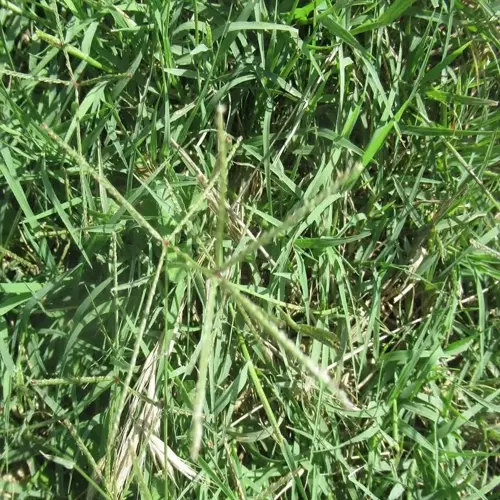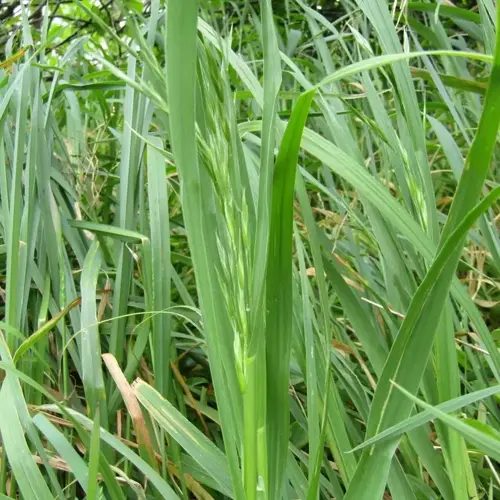

No. The two plants share a word and almost nothing else. The one spreading through your grass is Plantago major, a flat rosette pressed against the soil with broad oval leaves. Look at the veins. Each leaf carries 5 to 7 nearly parallel veins that run from base to tip, and that one mark settles most cases on its own. The cooking plantain is a banana relative grown for its starchy fruit, and it stands taller than you do. Settle plantain weed vs banana plantain on height alone and you are most of the way there.
The lawn plant never rises. Its leaves lie flat, spread out from one point at ground level, and the only thing that lifts off the soil is a thin flower stalk with no leaves on it. A cooking plantain grows overhead on a thick trunk-like stem, with paddle leaves longer than your arm. You would never mow over one by accident.
The overlap in names goes back a long way in English, and the two groups are far apart. Plantago is a large genus, roughly 250 species worldwide by UC IPM's count, and the two in your lawn are small broadleaf plants of paths and hard ground. The cooking plantain sits in the banana family instead, with the dessert banana as its close cousin. Two unrelated groups of plants ended up under one common word, which is the whole reason the question keeps coming up.
The Latin behind the weed's name explains its shape. Plantago comes from planta, meaning the sole of a foot, and that fits a plant whose leaves press themselves against the ground like a footprint. It handles being walked on, so you find it along paths, in playing fields and in the compacted strip beside a driveway. The name has described the same flat habit for centuries.
A third plant makes the tangle worse. The plantain lily hosta is the shade perennial people grow in beds on the north side of a house, and its wide ribbed leaves are what earned it that old nickname. It has no link to Plantago and none to bananas. So one word covers three unrelated plants, and only one of the three is the thing pushing up between your grass blades.
Kneel down and three checks will settle it. The leaves should all radiate from a single point at soil level in a basal rosette, with nothing resembling a woody stem. Break a leaf and watch the broken edge, because a true plantain shows no milky sap at all. Run a finger along the leaf and the stem and you will find no thorns and no papery sheath wrapped around the stem joints.
The flowers give you a fourth check in summer. They ride on leafless shoots 5 to 15 inches (13 to 38 cm) tall, which is the tallest this plant ever gets, and the flowers themselves are small and yellowish white. Most people walk past them without a second look. Anything with showy petals, a woody base or leaves held up on long stems is a different plant.
One practical note once you have the name straight. Look for control advice under Plantago major rather than plantain. A plain search for plantain hands you recipes for fried fruit and a stack of nursery pages for shade perennials. The weed name is the one that brings back turf and lawn guidance that matches what is at your feet.
Read the full article: Plantain Weed: Eat It or Get Rid of It