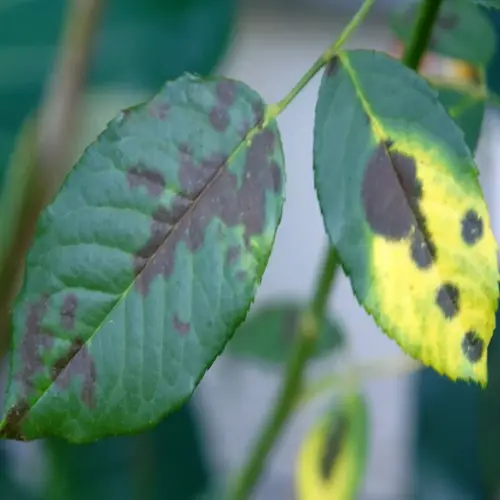

The fastest way to tell bacterial leaf spot vs fungal disease apart is the shape of the spots on your leaves. Bacterial spots tend to be angular with water-soaked edges because they follow the veins in your leaf. Fungal spots grow in round circles with ring patterns since they spread outward from a single point without any vein limits.
I figured this out after years of guessing wrong about what was hitting my tomato plants. The trick that changed everything for me was holding a spotted leaf up to sunlight. Bacterial spots look wet and see-through when you backlight them. The light shines right through the damaged tissue. Fungal spots stay dark and solid no matter how you hold the leaf. Once I learned this bacterial vs fungal leaf spot test, I stopped guessing and started treating the right problem on the first try.
Your next clue sits right on the surface of each spot. Fungi make visible spore structures that you can often see without a magnifying glass. Look for powdery, fuzzy, or velvety growth on top of the damaged area. Bacteria don't do this. A bacterial spot has a smooth surface with no raised texture or fuzz at all. If you see anything growing on top of the spot, you're most likely dealing with a fungal problem and not a bacterial one.
University plant pathologists point to spot shape as the most reliable field marker. Bacterial spots look angular and jagged because the bacteria travel along your leaf veins and stop at each vein wall. This creates irregular edges that follow the vein pattern on your leaf. Fungal spots don't care about veins at all. They push outward in a circle from their starting point, which is why they often show those clean round shapes.
Check the Spot Shape
- Bacterial sign: Spots have angular or jagged edges that follow the leaf vein pattern, giving them an uneven shape.
- Fungal sign: Spots grow in clean circles or ovals, often with rings inside them that look like a small target.
- Quick test: If you can trace a straight vein line along the edge of the spot, you're likely looking at a bacterial problem.
Look for Water-Soaked Margins
- Bacterial sign: Fresh spots have a wet or greasy look at their edges, and they turn see-through when you hold the leaf up to light.
- Fungal sign: Spot edges stay dry and crisp from the start with no wet or oily look to them at all.
- Best timing: Check your leaves early in the morning when dew is still on them since bacterial water-soaking shows up best then.
Check for Visible Spores
- Bacterial sign: The spot surface stays smooth and flat with no growth on top of it even after a week of wet weather.
- Fungal sign: You'll see powdery, fuzzy, or crusty growth on the spot surface, often in white, gray, or dark colors.
- Use a hand lens: A 10x magnifier helps you spot tiny fungal structures that your bare eyes might miss in the field.
Watch the Spread Pattern
- Bacterial sign: New spots often cluster on the side of the leaf that faces up since rain splash carries bacteria downward and outward.
- Fungal sign: Spots can appear on both sides of your leaf and spread to neighboring leaves through airborne spores.
- Pattern clue: Bacterial spread follows your watering pattern while fungal spread follows the wind direction in your garden.
Getting your leaf spot diagnosis right matters because the treatments are different. Copper sprays work well on bacteria but many fungal problems need a true fungicide instead. If you treat a bacterial infection with a fungal product, you waste time and money while the real problem gets worse. Use this checklist the next time you spot damage on your plants and you'll know which direction to go before you ever open a spray bottle.
Read the full article: Bacterial Leaf Spot: How to Identify and Control It