

Introduction
The spotted lanternfly is an invasive planthopper from Asia, and in most yards you have nothing worth treating. Scientists have observed it kill only grapevines, tree-of-heaven and black walnut saplings. Everything else it swarms gets sticky and stressed, and the trees that take the worst of it show dieback and decline rather than death. The one question worth your time is whether you own a plant that faces real risk.
Lycorma delicatula turned up in Berks County, Pennsylvania in 2014, and it was probably feeding here two or three years before anyone noticed. It most likely came in on imported plants, wood or stone. USDA APHIS now reports the insect in 19 states plus the District of Columbia, and Pennsylvania alone has 57 counties under quarantine as of 2026. The bug is a weak flier. It spreads because egg masses ride on cars, trailers, firewood and lawn chairs.
The worst spotted lanternfly damage shows up on farms. A 2019 Penn State study put the state's likely losses at $324.9 million a year and 2,810 jobs. That is the projection if the insect spreads unchecked across all 67 counties, and forest products carry the biggest share. A vineyard can lose whole blocks of vines. Nursery stock carries its own share of that projection, at $22.9 million a year.
In a yard the mess is honeydew. The insects feed on stems and bark and drip sugary waste on whatever sits below. Black sooty mold grows on that film, and heavy infestations have killed the groundcover under infested trees. So the hostas under your maple are the plants at risk. The tree above them may look ragged and still live. Your first move costs nothing. Walk the property between September and June and look for gray egg masses that look like a smear of dried, cracked mud. They sit on trunks, fence posts and car bumpers. Scrape them into a bag of rubbing alcohol.
What A Spotted Lanternfly Kills
A spotted lanternfly has no jaws. It has a piercing-sucking mouthpart, a straw it pushes into stems, leaves and bark to drink sap. It never feeds on the fruit. So spotted lanternfly damage begins as a slow drain on the plant, and hundreds of insects on one trunk pull enough sap to leave that plant stressed. What pours out the other end is a sticky sugar rain called honeydew.
Two of the six grapevines I put on a backyard wire trellis never leafed out the spring after the swarm. The other four came back thin. The silver maple 20 feet (6 m) away carried just as many insects that fall, and it is still standing and still leafing out on time. Grapevine loss is what the research confirms again and again. Maples show dieback and decline, with no confirmed death.
Do spotted lanternflies kill trees? In almost every case, no. A heavy feeding year can leave a tree with wilted branch tips, oozing sap and a rough winter, and that tree is still there the next summer. The confirmed kill list is short, and it has stayed short since the insect showed up here in 2014.
To date, scientists have seen spotted lanternfly kill only grapevines, tree of heaven and black walnut saplings.
The second half of the damage story happens under the tree. Honeydew coats the plants below a feeding group. Black sooty mold grows on that sugar, and the mold has killed groundcover under heavy infestations. You fix that by cutting the number of bugs in the branches above. This insect is also not known to carry plant disease, so the bugs moving from tree to tree are not spreading one.
Spot It At Every Life Stage
A small black bug covered in white spots turns up on a young stem in June. What is it? A spotted lanternfly nymph, and the calendar answers that before the field marks do. First instars hatch beginning in May and the black stages run through July, so almost nothing else in the yard wears that pattern then. Cornell University notes people sometimes take a first instar for a tick, so watch for the hard sideways jump no tick can make.
What does a spotted lanternfly look like? Four different things, depending on the month you look. That is what makes spotted lanternfly identification harder than it sounds. The black and white nymphs turn red with black stripes by July, and the moth-like adult most people picture shows up from July on. Read the stages below in order of month, size and color, and note where on the plant you are standing, because the young stages crowd onto tender new growth while adults sit head down on bark.
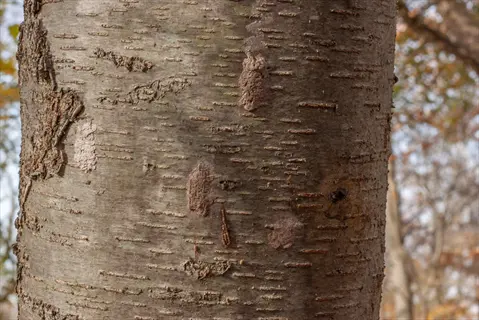
Egg Masses
- Months: Masses go up from September into November and stay on outdoor surfaces through June, the longest removal window of the year.
- Size: Each mass runs about 1 inch (2.5 cm) long and holds 30 to 50 eggs set in four to seven parallel rows.
- Fresh look: A new mass wears a white putty coating that dries within a few weeks into a dull tan patch resembling cracked mud.
- Older look: Once the coating wears off, the rows of seed-like eggs sit exposed and read as tiny brown beads in a neat grid.
- Where to look: Bark, stone, fence posts, grills, patio furniture, trailers and vehicles all qualify, since egg masses turn up on any outdoor surface, not just bark.
- What to do: Scrape into a sealed bag with rubbing alcohol or hand sanitizer, and confirm the identification first because beneficial insects lay similar masses.
Early Nymphs, First Through Third Instar
- Months: First instars hatch beginning in May, and the first three stages run from May through July across most of the range.
- Size: They start smaller than a grain of rice and reach roughly 1/4 inch (6 mm) by the third stage, which makes them easy to miss.
- Color: Solid black bodies covered in bright white spots, with no red anywhere, which is the fastest way to place the stage.
- Where to look: New growth first, so tender stems, leaf stalks and the growing tips of vines rather than thick bark.
- Behavior: They jump hard when disturbed, which is why a slow hand or a lazy swat usually comes back empty.
- What to do: A shop vacuum clears clusters off new growth and avoids the bycatch problem that open sticky bands create.
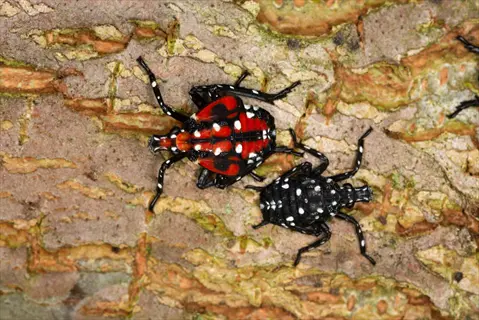
Late Nymphs, Fourth Instar
- Months: The fourth stage runs from July into mid-August and overlaps with the first adults of the season.
- Size: About 1/2 inch (1.3 cm) long, noticeably larger and bolder than the black stages that came before it.
- Color: Bright red panels edged with black stripes and scattered white spots, easily the most recognizable stage of the year.
- Where to look: They shift toward woody tissue and a narrower set of host plants than the earlier stages use.
- Look-alikes: Boxelder bug and small milkweed bug are the two insects Utah State University Extension names as look-alikes for this stage.
- What to do: Circle traps catch nymphs while they still climb trunks, without the exposed adhesive that a bare sticky band leaves out.
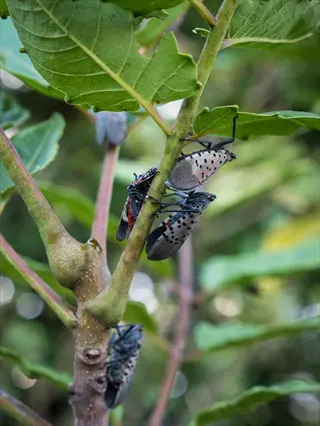
Adults
- Months: Adults appear in July and can be found through December, with egg laying starting in September.
- Size: About 1 inch (2.5 cm) long and 1/2 inch (1.3 cm) wide at rest, with females slightly larger than males.
- Wings closed: Brown forewings carrying black spots and a speckled band at the rear, which is what shows on a trunk.
- Wings open: Scarlet hind wings marked with black spots and white and black bars, visible only during a jump or short flight.
- Body: A yellow abdomen banded in black shows between the wings while the insect feeds head down on bark.
- What to do: Adults land on siding for warmth or height and cause no structural damage, so do not treat the wall; assess whether a vulnerable plant needs protection first.
Egg masses are the one stage worth slowing down for. A fresh mass looks like wet gray putty and an old one like a patch of cracked mud, both about 1 inch (2.5 cm) long, and several harmless insects lay masses that read much the same at arm's length. Confirm what you have before you scrape. Guess wrong and you destroy a clutch of beneficial eggs, and the masses sit on outdoor surfaces from September through June, so you have months to be sure.
How Lanternflies Travel So Fast
Park under an infested maple in October and a female can glue an egg mass onto your bumper that same week. It looks like a smear of wet gray putty, and it dries to something close to cracked mud. Cornell University notes eggs sit on any outdoor surface from September through June. So that mass rides along all winter and hatches in May in a county two states away. Most spotted lanternfly spread works like this. The insect is a poor flier and a first-rate passenger.
Researchers put the insects on five vehicle surfaces and ran wind across them. Every mobile life stage held on at wind speeds up to 62 mph (100 km/h), and about 30% were still attached at that top speed. Wiper blades and the scuttle panel, the vented strip below your windshield, kept them longest, with mean detachment near 52 mph (83.8 km/h). Hitchhiking on vehicles is not a slow crawl to the next town. One highway trip moves a nymph as far as you drive that day.
Weak Fliers, Strong Hitchhikers
- Flight: The insect is not a strong flier and mostly jumps and glides, so its own power moves it only short distances each season.
- Real driver: Range expansion is driven by human movement of vehicles, outdoor furniture and other objects that females glue egg masses onto.
- Evidence: A 2024 experiment found every mobile life stage could hold onto a moving vehicle at speeds up to 62 mph (100 km/h).
The Vehicle Surfaces That Hold Them
- Stickiest spots: Wiper blades and the scuttle panel below the windshield held insects longest, with mean detachment near 52 mph (83.8 km/h and 83.0 km/h).
- Weakest spots: The hood and the nose wing shed insects earlier, at roughly 40 mph (64.0 km/h and 65.4 km/h).
- Who holds on best: First instar nymphs and early-season adults held at the highest wind speeds, and females out-held males.
Where They Are Now
- National picture: USDA APHIS reports 19 states plus the District of Columbia with some level of infestation.
- Epicenter: Pennsylvania carries 57 quarantined counties as of 2026, though a county in quarantine does not mean every town in it has insects.
- Spread pattern: Satellite populations sit along major highways and cargo rail lines rather than radiating evenly from Pennsylvania.
Quarantine Rules And Reporting
- Before you drive: Check doors, sides, bumpers, wheel wells, grills and roofs, and park 15 feet (4.6 m) away from trees inside a quarantine zone.
- Businesses: Companies moving regulated articles may need a permit depending on the state, and should check shipping containers, propane tanks and pallets.
- Reporting: Report a sighting to your state agriculture department, or call 1-888-422-3359 in Pennsylvania, especially outside a known quarantine county.
Some level of infestation now shows up in 19 states plus the District of Columbia, and Pennsylvania alone holds 57 quarantined counties as of 2026. Maryland's spotted lanternfly quarantine covers all 23 counties plus Baltimore City. A county under quarantine does not mean every yard in it has insects. It means the rules apply to you when you load a car, a trailer or a stack of firewood.
Inside a quarantine zone, park 15 feet (4.6 m) away from trees when you can, then walk the car before a long drive and check the doors, sides, bumpers, wheel wells, grills and roof. Report spotted lanternfly sightings to your state agriculture department, and in Pennsylvania call 1-888-422-3359. A sighting outside a known quarantine county is the one worth the phone call. That is where an early find still changes the map.
Before a long drive out of a quarantine county, look at the wiper blades and the panel below the windshield. Those two places held insects at highway speed in testing.
The Real Cost Of This Invasion
In 2019, Harper, Kelsey, Kime and Stone at Penn State ran the numbers for the Center for Rural Pennsylvania. They asked one question. What would the state lose every year if the spotted lanternfly reached all 67 counties? Their answer was $324.9 million and 2,810 jobs a year, with a worst case of $554.0 million and 4,987 jobs.
Those numbers are a model, not a count. The team built it in IMPLAN, using the 2017 Census of Agriculture and Forest Inventory and Analysis data. Interviews with people in the trades at risk filled the gaps. So the spotted lanternfly economic impact you meet on other pages is a forecast. It shows what the state stands to lose if nothing slows the bug down. The Pennsylvania Department of Agriculture quotes the same study, rounded to $324 million a year and more than 2,800 jobs.
Forest products carries the biggest share at $152.6 million, so timber industry losses are the quiet half of this story while vineyard damage takes the headlines. Grapes earn that attention, since grapevines are one of the few plants the insect is observed to kill outright. The nursery sector sits at $22.9 million. The study priced the response too. Best management practices came to $27.9 million for the quarantine zone of the day and $219.6 million if the state rolled them out everywhere.
Even if the worst-case scenario doesn't come to pass, the spotted lanternfly already has inflicted millions of dollars in damage to our state's agriculture and forestry industries.
For scale, the same study modeled the 14 counties then under quarantine on their own at $50.1 million and 484 jobs. That is one corner of one state. Those counties held about a fifth of Pennsylvania and roughly a sixth of the projected loss. That is the size of the agriculture threat before the bug had a shot at the other 53 counties, and the Pennsylvania figure that lands in your local news traces back to this same model.
Should You Treat At All?
Should I spray for spotted lanternflies? In most yards, no. University of Maryland Extension advises leaving the insects to predators in most residential cases. Spotted lanternfly treatment makes sense when you own one of the few plants from the damage list above, and backyard grapes are the clearest case of all.
Two rules hold either way. Do not spray your lawn, because the insect does not live in grass and the spray reaches only the species you wanted to keep. Skip the broad pyrethroids sold for yard use as well, since they kill pollinators along with the target. Maryland goes further. A home gardener there is not allowed to put dinotefuran or the other neonicotinoids on a tree in the yard. That ban is the Maryland Pollinator Protection Act of 2016, so a systemic insecticide a tree service injects may be off limits to you.
- Backyard grapevines, the clearest residential case for active control.
- A young black walnut, since saplings are among the confirmed deaths.
- A heavy, repeated infestation on a tree already stressed by drought or injury.
- A property carrying tree-of-heaven, which acts as a local breeding hub.
- Mature maples, where sources report dieback and decline but no confirmed death.
- A scatter of adults on siding, since they cause no structural damage.
- Lawns, where the insect does not live and spraying only harms other species.
- Any plan that starts with an untested homemade spray.
Penn State Extension says the call comes down to tree type, tree health and infestation level, with no single answer that fits every yard. A stressed sapling hit hard two years running is a different problem from 30 adults on a healthy maple. If you do treat, pick the least toxic product that will do the job, and keep it off anything in bloom while pollinators are working. That last part rules out blanket spraying a flowering tree, and pollinator safety is the step most homeowners skip.
"They are all over the maples, I am calling someone Monday," my neighbor told me over the fence line last September. Her trunks had honeydew running down the lower bark and a black film on the hostas below. She never made the call. Both maples leafed out on schedule the following spring.
Spotted lanternfly is mainly a nuisance pest in residential gardens and landscapes and has not been shown to significantly damage otherwise healthy ornamental plants.
Lanternfly Control That Works
How to get rid of spotted lanternflies is mostly a question of timing. Start with the gentlest step the season allows and you handle most of a home yard without a sprayer. University of Maryland Extension puts sprays last in a home yard, and it warns off the dish soap and vinegar mixes people trade online. Those are untested and can hurt pets, plants and people.
I was on a ladder at the back fence one November with a putty knife in one hand and a jar of rubbing alcohol in the other. The two silver maples there held 11 gray masses, most of them at chest height on the shaded side of the trunk. Each mass holds 30 to 50 eggs. I scraped them into the jar, capped it and put it in the trash. Egg mass removal has the longest window of any method here, because eggs sit on outdoor surfaces from September through June.
- Scrape egg masses: From September through June, scrape masses into a bag or jar of rubbing alcohol or hand sanitizer, then seal it before disposal.
- Set circle traps: Circle traps funnel climbing nymphs into a collection container and avoid the bycatch problem open sticky bands create.
- Screen any sticky band: Cover a sticky band with wire screen so birds, squirrels and pollinators cannot land on the adhesive.
- Remove tree-of-heaven: Cutting alone backfires, because root fragments resprout, so follow local extension guidance on herbicide treatment.
- Vacuum clustered nymphs: A shop vacuum clears a cluster faster than swatting, and these are strong jumpers that dodge a slow swing.
- Report new sightings: Tell your state agriculture department, or call 1-888-422-3359 in Pennsylvania, especially outside a known quarantine county.
A circle trap wraps the trunk and funnels climbing nymphs into a container, so there is no open glue surface for a chickadee to land on. Utah State University Extension keeps sticky traps for confirmed infestations, not for a yard where you spotted three adults in August. Tree of heaven removal is the slower job. Cut a stem and the roots push up a thicket of new shoots, so the cut has to be paired with an herbicide treatment, and your state extension office has the timing for your area.
An uncovered sticky band catches birds, squirrels and beneficial insects along with the target. Add a wire screen cage, or use a circle trap instead.
Nothing on a store shelf gives you biological control yet. Researchers are testing a fungus called Beauveria bassiana, plus two tiny wasps that hit lanternfly eggs and nymphs back in Asia. The wasps are Anastatus orientalis and Dryinus sinicus. That work is still in progress. Scraping and trapping are what you have this season.
Common Myths
Spotted lanternflies will kill the maples and other shade trees in an average yard within a season or two.
Scientists have confirmed kills only in grapevines, tree-of-heaven and black walnut saplings; maples and black walnut show dieback and decline, not death.
One hard winter will freeze the local population out, so there is no reason to scrape egg masses in the cold months.
Eggs can survive temperatures around 12F (-11C), so a cold winter is no guarantee that egg masses die before the May hatch.
A homemade dish soap or white vinegar spray is the safe, natural way to handle them around the house.
University of Maryland Extension calls those sprays untested and not science-based, and warns they can harm people, pets, other animals and plants.
They bite, sting, or chew their way into houses, decks and outdoor furniture given enough time.
They do not bite or sting and cause no structural damage; the mess on a deck is honeydew and the black sooty mold that grows on it.
They fly into new towns under their own power, so nothing a driver does changes how fast they spread.
They are weak fliers, yet every mobile stage can ride a car at 62 mph (100 km/h), so vehicle checks reduce human-assisted spread.
Conclusion
A serious pest for vineyards and timber, and a sticky nuisance in most yards. That single line sets your job for the rest of the spotted lanternfly season. Adults are feeding on trunks now and they start laying eggs in September, so walk the yard this week and look over any grapevine, maple, black walnut or tree of heaven you own.
Your spotted lanternfly control calendar runs on four dates. When to scrape egg masses? Any time from September through June, off bark, stone, fence rails, grills and car bumpers, since that is the whole stretch when eggs sit on outdoor surfaces. First instars hatch beginning in May. The red fourth instars run July into mid-August, and the adults lay until November or the first killing freeze, whichever comes first.
Penn State Extension says the insect is likely here to stay, so set your goal at cutting local numbers and saving the grapes, not clearing your property. Reported sightings in Pennsylvania did fall year over year in 2026, and one county logged 211 reports in the first half of one year against 104 in the next. Those are report counts and not a population census. Fewer reports does not mean the insect is gone.
Pick one job this week and do it. If you park under trees in a quarantine county, check the wiper blades and the panel below the windshield before you drive out. Those two spots held onto insects at highway speed better than any other surface tested. Then set a reminder for after the first killing freeze, when eggs are the only stage left to hunt.
Glossary
- Circle trap
- A funnel-shaped trap wrapped around a trunk that guides climbing insects into a sealed container without exposed adhesive.
- Egg mass
- A patch of 30 to 50 eggs laid together on bark or any smooth outdoor surface and covered with a putty-like coating.
- Honeydew
- The sticky sugary liquid a sap-feeding insect excretes, which drips onto whatever sits below the plant it is feeding on.
- Instar
- A single growth stage between molts in a young insect's life, so a fourth instar is a nymph on its fourth stage before adulthood.
- Piercing-sucking mouthparts
- A straw-like mouth built to pierce plant tissue and draw out sap, rather than jaws that chew leaves.
- Sooty mold
- A black fungus that grows on honeydew, coating leaves, decks and cars in a dark film without infecting the plant itself.
- Sticky band
- A strip of adhesive tape wrapped around a trunk, which needs a screen cover because it also catches birds and squirrels.
- Tree-of-heaven
- An invasive tree, Ailanthus altissima, that spotted lanternflies prefer above almost any other host plant.
External Sources
Frequently Asked Questions
What does a spotted lanternfly look like?
It changes appearance four times a year:
- Egg mass: a 1 inch (2.5 cm) gray patch that dries like cracked mud
- Early nymph: black with bright white spots, up to about 1/4 inch (6 mm) long
- Late nymph: bright red with black stripes, about 1/2 inch (1.3 cm) long
- Adult: about 1 inch (2.5 cm) long, brown spotted forewings over scarlet hind wings
How do you kill spotted lanternflies?
Scrape and seal egg masses, set circle traps on infested trunks, and skip untested home sprays.
What do spotted lanternflies eat?
They drink sap pierced from stems, leaves and bark rather than the fruit, from at least 103 plant species in the United States (University of Illinois Extension, 2021).
Which states have the most spotted lanternflies?
Pennsylvania remains the epicenter with 57 quarantined counties as of 2026, while 19 states plus the District of Columbia report some level of infestation.
What makes spotted lanternflies so bad?
The harm is economic and ecological rather than structural or medical:
- Confirmed plant kills in grapevines, tree-of-heaven and black walnut saplings
- Honeydew and black sooty mold coating leaves, decks and parked cars
- Modeled Pennsylvania losses of $324.9 million a year and 2,810 jobs
Why do spotted lanternflies leave a sticky mess?
Sap feeding produces honeydew, a sugary excretion that rains onto whatever sits below, ferments to a vinegar-like smell and feeds black sooty mold.
Does dish soap kill spotted lanternflies?
A bucket of hot soapy water is a recognized way to destroy scraped egg masses, but University of Maryland Extension warns that dish soap sprays are untested.
Does vinegar kill spotted lanternflies?
No tested evidence supports it, and University of Maryland Extension lists white vinegar sprays as not science-based and potentially harmful to people, pets and plants.
Do spotted lanternflies bite or sting?
No. Penn State Extension states they do not bite or sting, and the Illinois Department of Natural Resources reports no human or animal health concerns.
How do you keep spotted lanternflies off your property?
Remove tree-of-heaven, scrape egg masses from September through June, and inspect vehicles and outdoor items before leaving a quarantine county.