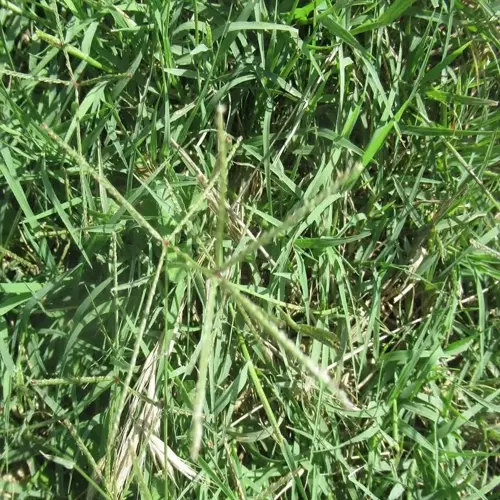

Nutsedge shoots past mowed turf in a day or two, so the patch stands out in bright yellow-green spikes well before your next cut. That head start is your opening. Selective nutsedge control comes down to one choice, and that choice is a herbicide with a sedge active listed on the label for the turf you actually have. Get that line right and the sedge dies while the grass around it keeps growing.
Start with the label instead of the shelf tag. A product cleared for one turf species is not cleared for every turf species, and the label carries the list of grasses it is safe on. Match your lawn to that list before you look at anything else on the bottle. Price and brand matter less than that one block of small print, and reading it takes about a minute. If your grass is not named on that list, put the bottle back and keep looking.
Selective nutsedge control is not magic. A sedge is not a grass and it is not a broadleaf weed, and a handful of actives work on that difference. Penn State Extension lists six of them for turf, and four are bentazon, sulfentrazone, mesotrione and pyrimisulfan. The other two on that same list are halosulfuron-methyl and imazosulfuron. Any nutsedge killer for lawns worth your money names one of those, either on the front panel or in the ingredient block on the back.
Timing will not save you here. UC IPM is blunt about it. No preemergent that works on nutsedge can be used on turfgrass, so there is nothing to put down in early spring that stops the shoots before they show. You treat what you can see. A slow walk around the yard once a week does more for you than any spray calendar, because it puts you in front of each patch while it is still small.
Selective nutsedge control depends as much on how you spray as on what you spray. Clemson advises watering the lawn the day before an application, and skipping postemergence sprays in hot, dry weather above 90°F (32°C). Wait for a cooler, calmer stretch instead. There is no rush on your side, because the sedge will still be sitting there in two days. Set a sprinkler the evening before, and the watering step is already done when you walk out with the sprayer.
Mowing is the rule most people break. Curtail mowing for at least 2 to 3 days before and after you apply, and put those dates on a calendar if a service cuts your yard on a fixed day. One pass with the mower on the wrong morning undoes the work. Read the reseeding limits while you are at it, because imazaquin allows no seeding or overseeding for 6 weeks after it goes down.
Spot treating nutsedge beats blanket spraying when you have a few clumps instead of a lawn-wide problem. You buy less product, you spend less time, and the rest of the turf never takes a drop. Mix at the rate the label gives, apply it the way the label directs, and cover the patch and no more of the lawn than that. Then follow the retreatment interval on the bottle and go back for whatever comes up again. Rinse the sprayer out when you finish so the next job does not pick up leftovers.
The last piece is the lawn itself. Feed it on schedule, mow on a regular cycle, and a thicker stand of turf slows how fast the sedge spreads through it. There is a limit worth knowing about, though. Better density slows the spread but may not suppress an established stand. Steady feeding and mowing slow the sedge down, and a labeled herbicide deals with the patch already sitting in your yard.
Read the full article: Nutsedge: How to Kill It and Keep It Out